
The Old Bank premises at Broad Street in South Molton. Credit: Google Street View
Search


12 Mar 2026

Please allow ads as they help fund our trusted local news content.
Kindly add us to your ad blocker whitelist.
If you want further access to Ireland's best local journalism, consider contributing and/or subscribing to our free daily Newsletter .
Support our mission and join our community now.
To continue reading this article, you can subscribe for as little as €0.50 per week which will also give you access to all of our premium content and archived articles!
Alternatively, you can pay €0.50 per article, capped at €1 per day.
Thank you for supporting Ireland's best local journalism!

Near Woolacombe beach. © Copyright Lewis Clarke

Councillor Ken James, leader of Torridge District Council, has called on residents across Torridge and wider Devon to take part in a major Government consultation on the future of local government in the county.
The consultation, launched by the UK Government’s Ministry of Housing, Communities and Local Government, seeks views on a series of proposals to reorganise how councils operate in Devon, Plymouth and Torbay in a move that could reshape local services from 2028.
At present Devon operates under a two‑tier system of local government.
Under that model, Devon County Council is responsible for services such as education, transport and adult social care, while eight district councils, including Torridge, handle functions such as waste collection, housing, planning and environmental health.
Plymouth and Torbay are already unitary authorities, meaning they provide all local services within their boundaries.
Councillor James said the consultation represents “your last chance to influence how your area is governed for future decades” and urged residents, businesses, voluntary groups and town and parish councils to take part before it closes.
The Government’s consultation comes as part of a wider drive to simplify council structures across England and support long‑term sustainability of local services.
In December 2024, ministers published a policy framework calling on areas with two‑tier local governments to develop plans to move to a single‑tier unitary model, where one council delivers all services across a given area.
That White Paper formed part of the Government’s English devolution agenda, promoting clearer accountability, fewer overlapping responsibilities and more coherent strategic planning.
Supporters of reorganisation argue that larger unitary authorities can deliver services more efficiently, reduce duplication, and provide a stronger, unified voice for their communities when working with central government and regional partners.
Critics, including some council leaders nationally, have raised concerns about disruption, cost and risks of reduced local representation under larger authorities, but ministers say the transition is necessary to modernise local government.
Across Devon, councils and local authorities have submitted a range of competing proposals to Government as part of the reorganisation process.
One of the key submissions, supported by Torridge District Council and six other district councils, is known as the Reimagining Devon proposal.
This model, sometimes called the 4‑5‑1 model, would see the county reorganised into three new unitary authorities:
A variation on this plan, called the 4‑5‑1+ proposal, includes a modest expansion of the Plymouth authority’s boundaries into neighbouring parishes.
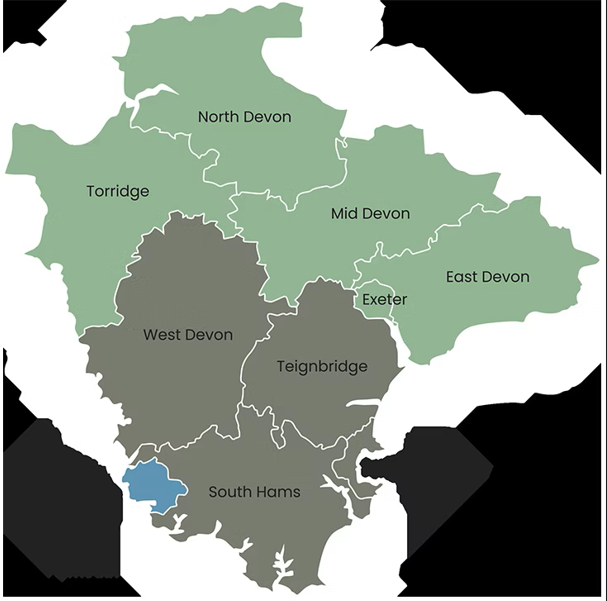
ABOVE: Proposed unitary council areas under the Reimagining Devon plan: Grey – Torbay and Southern Devon, Green – Exeter and Northern Devon, Blue – Plymouth. Image credit: Reimagining Devon
Other proposals submitted include alternative models from Devon County Council, Exeter City Council, and Torbay Council, each envisioning different configurations of unitary authorities across the area.
The Government has published all five of these submissions as part of the consultation materials.
The public consultation opened on 5 February 2026 and will run until 26 March 2026, giving residents and organisations a chance to review all five proposals and submit their views either online, by email, or by post.
After the consultation closes, ministers will consider responses before making a final decision on whether to accept one of the submitted proposals, request modifications, or pursue an alternative path.
That decision is expected in summer 2026, with legislation to create the new authorities then drafted.
If approved, elections for the new councils are planned for May 2027, with a ‘shadow’ year preparing for the hand‑over of responsibilities ahead of full implementation in April 2028.
Supporters of the Reimagining Devon plan describe it as a structure that reflects local communities, travel‑to‑work areas and economic geographies, while also ensuring greater financial resilience and stronger service delivery.
They say it balances the need for scale with local accessibility.
Councillor James emphasised that district councils currently play a key role in everyday services tailored to local needs, and warned that significant change is ahead.
“This is all set to change,” he said, urging widespread participation in the consultation.
For many residents, the outcome of this consultation will determine how key services, from housing support to waste collection and planning, are delivered in the coming decades.
With councils at the heart of local community life, the Government has said that every response will be treated equally and that the consultation is a chance for voices across Devon to be heard.
Full details of all proposals and how to respond to the consultation can be found on the Government’s website and the dedicated Devon LGR portal.

Subscribe or register today to discover more from DonegalLive.ie
Buy the e-paper of the Donegal Democrat, Donegal People's Press, Donegal Post and Inish Times here for instant access to Donegal's premier news titles.
Keep up with the latest news from Donegal with our daily newsletter featuring the most important stories of the day delivered to your inbox every evening at 5pm.