The Old Bank premises at Broad Street in South Molton. Credit: Google Street View
Search


12 Mar 2026

Please allow ads as they help fund our trusted local news content.
Kindly add us to your ad blocker whitelist.
If you want further access to Ireland's best local journalism, consider contributing and/or subscribing to our free daily Newsletter .
Support our mission and join our community now.
To continue reading this article, you can subscribe for as little as €0.50 per week which will also give you access to all of our premium content and archived articles!
Alternatively, you can pay €0.50 per article, capped at €1 per day.
Thank you for supporting Ireland's best local journalism!

In case you wondered what was happening, hundreds of people in Landkey went a-wassailing last weekend! Credit: Jacob Houghton

An ancient tradition revived by a North Devon village is growing in popularity – and this year’s Landkey Wassail was the biggest yet.
Held in the mazzard orchard at the Landkey Millennium Green, the wassail is a lively mix of music, rhyme and pagan ritual. This year’s event was held on Saturday (January 17) and saw around 400 people joining the fun to encourage the trees to give a good crop in the coming year.
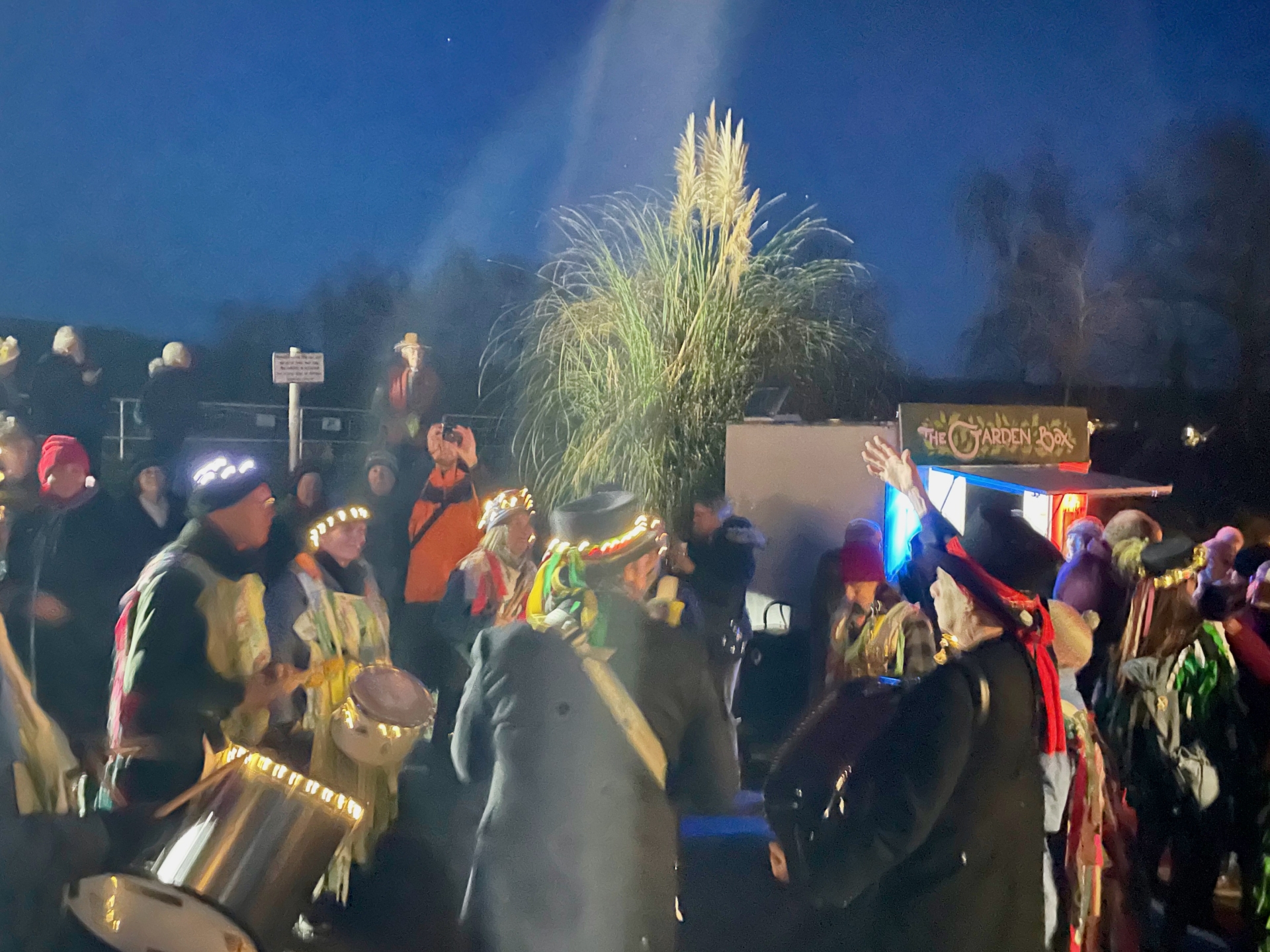
Above: The Landkey wassail procession sets off. Credit: Lo Winchurch
First held in Landkey in 2019, the event’s roots can be found in another unique village tradition – the Landkey Carols. This is a partnership between local singing group Landkey Sings and music education charity Wren Music to revive traditional Christmas carols from the 19th century which were unique to Landkey.
Since 2016, the group has been convening every year to sing carols originally sung by local farm worker and in the village Methodist chapel.
The first wassail came about when Landkey business Green Man Cider linked up with Landkey Sings, resulting in a modest ceremony on the Millennium Green followed by a sit-down meal in the village hall and traditional songs performed by Paul Wilson and Marilyn Clarke from Wren Music.
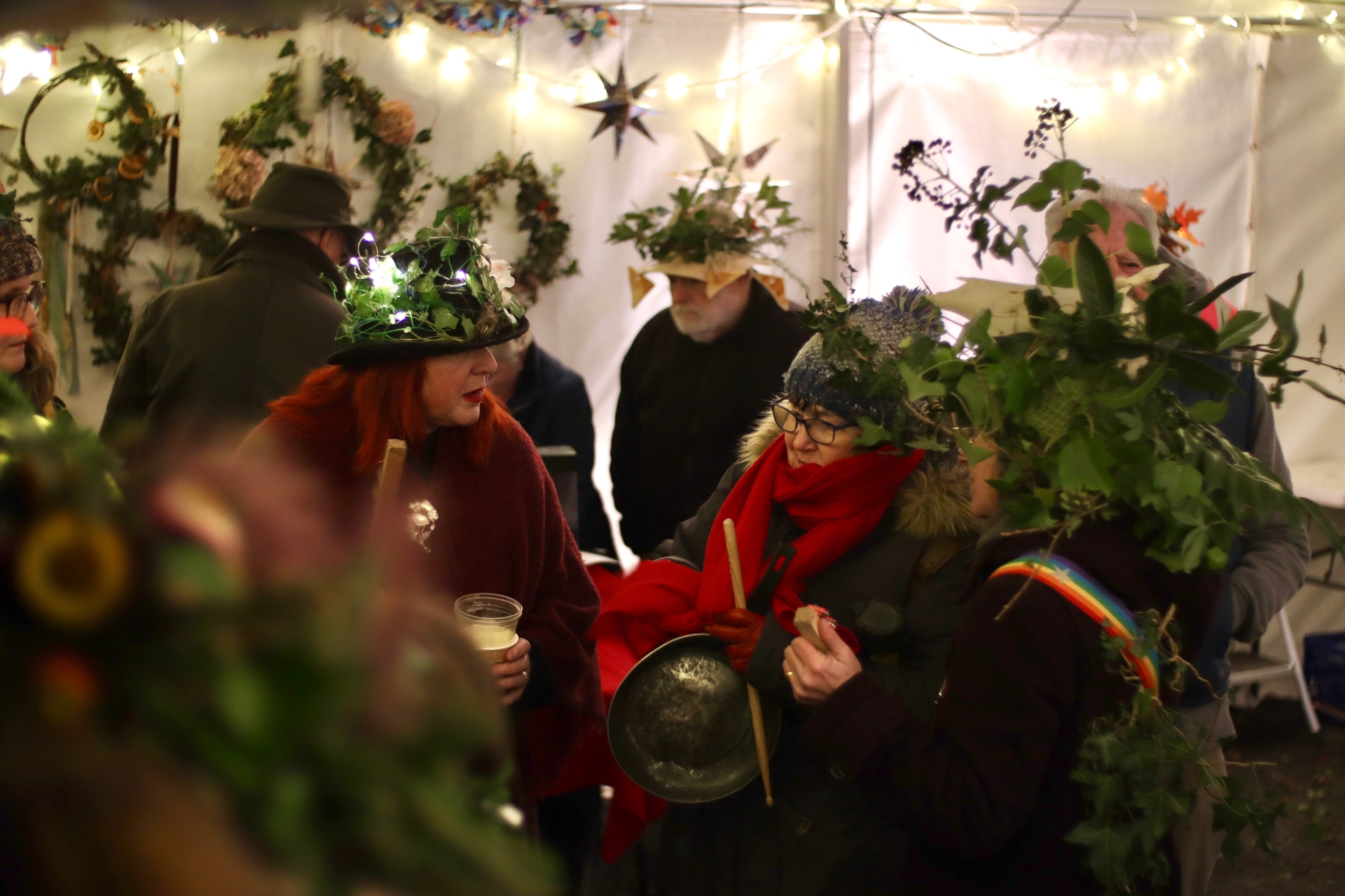
Above: Hats are decorated with foliage as part of the wassail tradition. Credit: Jacob Houghton
Since then, the wassail has ballooned, with a marquee, mulled cider, hot food, fireworks and elaborately-decorated hats.
During the ceremony, villagers walk in procession to the mazzard trees, one by one, anoint them with cider, recite a wassail song or rhyme and make as much noise as possible. In Landkey, the trees are also ‘nourished’ with pieces of toast hung to the branches.
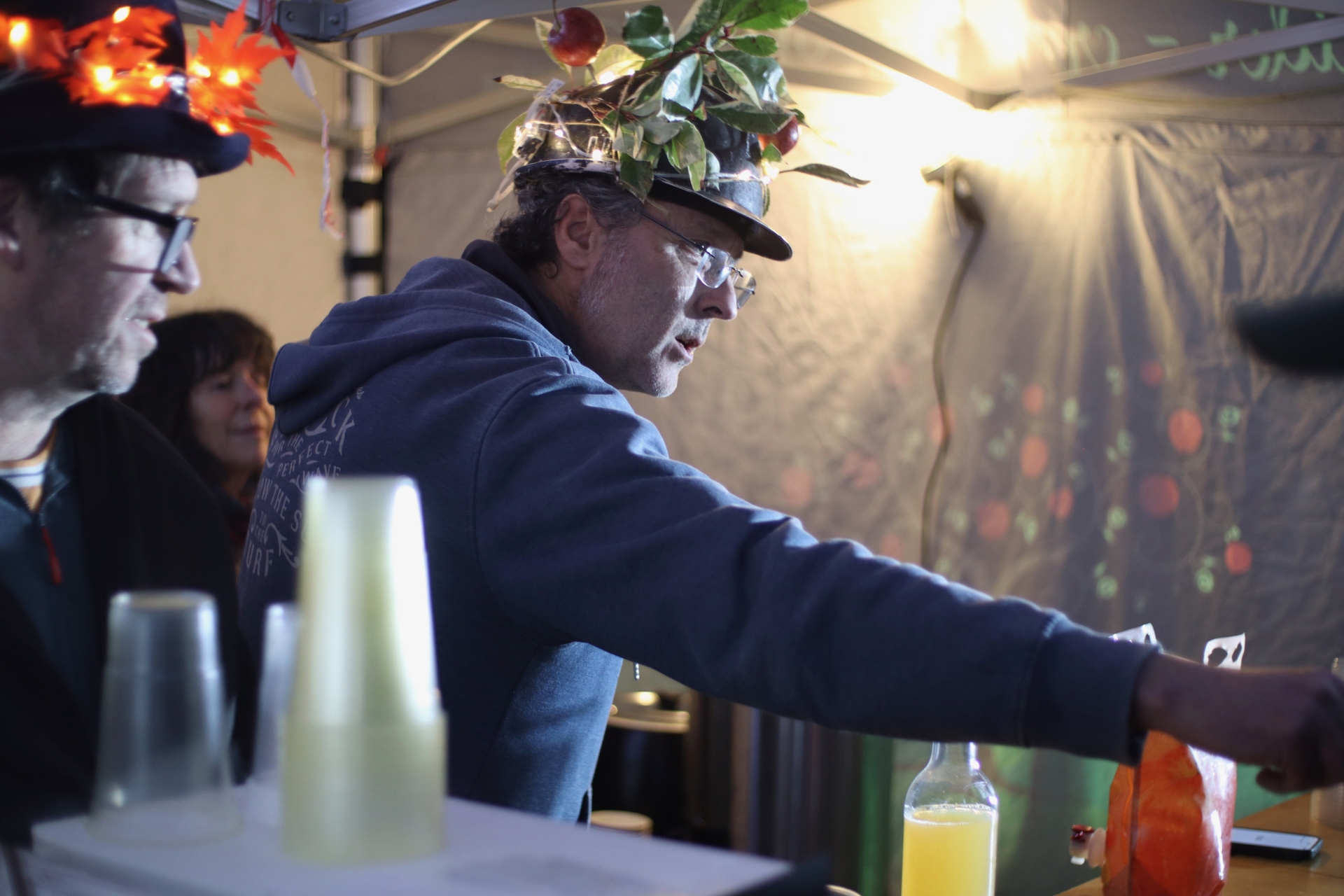
Above: Mulled cider plays a big part in wassailing festivities. Credit: Jacob Houghton
Becky Houghton, one of the organisers, explained: “It's a pagan ritual that goes back a very, very long time. So, it seems to be having a resurgence. You hear about wassails all over the country.
“Because what a lovely thing it is to sing to the trees, scare away evil spirits, hang toast up to feed the trees and ensure a good harvest.
“It's just nice, tying you to the land and the trees and the cycles of the earth and I think people want that these days.”
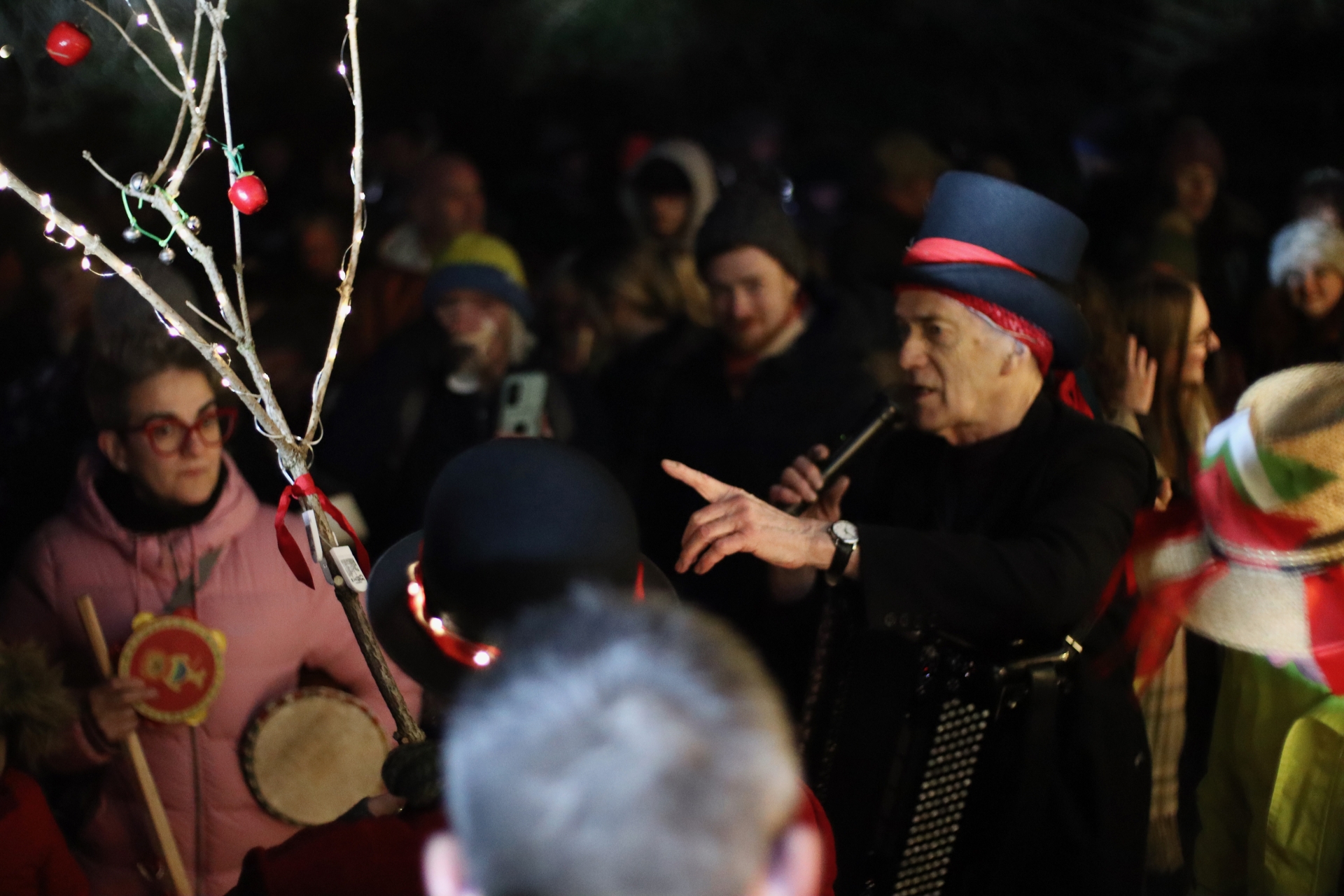
Above: Music forms a large part of the tradition. Credit: Jacob Houghton
Another organiser, Richard Prowse, added: “We've been amazed at the response. When you look around on these nights, most of the people that come, by far the majority, are local Landkey people, village people.
“There is a need for it. And when we did it just immediately after covid, you could see people were just so delighted to be out and talking to each other again. And it was a great feeling.”
Planning is already under way for next year’s event. The organisers are determined to keep it free of charge and are looking at possible dates, hopefully tying it in with the phases of the moon as it was in ancient times.
Looking further ahead, the prospect of a new community hall next to the Millennium Green could give the wassail a whole new dimension.
The organisers were particularly grateful to the local businesses which have supported the event and developer Allison Homes which also provided sponsorship this year.
You can find out more about the Wassail on the Landkey Sings Facebook page, https://www.facebook.com/landkeysings
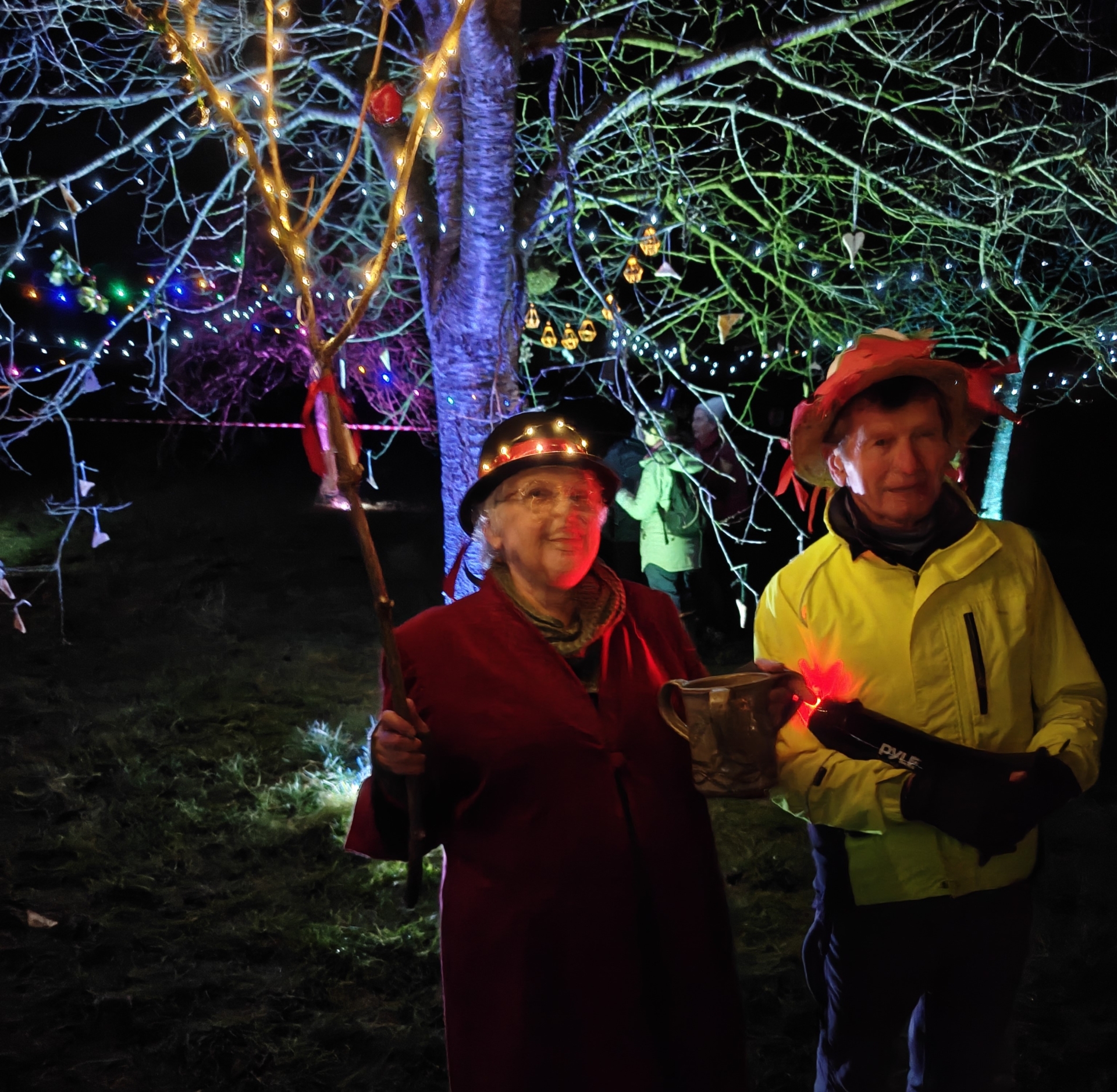
Above: Richard Prowse (right), one of the organisers, helps ward off the evil spirits. Credit: Becky Houghton
According to the National Trust, wassailing is a Twelfth Night tradition with pagan roots and has been practised in Britain for centuries. The purpose is to encourage the spirits into ensuring a good harvest the following season.
It usually took place on the twelfth night after Christmas and involved a visit to a nearby orchard for singing, dancing, drinking and general merrymaking.
Historically, wassailing took many different forms, depending on local tradition. Revellers typically visited local orchards and fruit trees, sang songs, made a hullabaloo (often by banging pots and pans) and were rewarded by the orchard’s grateful owner with some form of warm, spiced alcoholic drink from a communal wassail bowl or cup. Sometimes a topping of apple, known as ‘lamb's wool’, would be added.
The intention was to ward off bad spirits from the orchards whilst also pleasing the spirits of the fruit trees, to ensure a bountiful crop of fruit in the year ahead.

Subscribe or register today to discover more from DonegalLive.ie
Buy the e-paper of the Donegal Democrat, Donegal People's Press, Donegal Post and Inish Times here for instant access to Donegal's premier news titles.
Keep up with the latest news from Donegal with our daily newsletter featuring the most important stories of the day delivered to your inbox every evening at 5pm.