The Old Bank premises at Broad Street in South Molton. Credit: Google Street View
Search


12 Mar 2026

Please allow ads as they help fund our trusted local news content.
Kindly add us to your ad blocker whitelist.
If you want further access to Ireland's best local journalism, consider contributing and/or subscribing to our free daily Newsletter .
Support our mission and join our community now.
To continue reading this article, you can subscribe for as little as €0.50 per week which will also give you access to all of our premium content and archived articles!
Alternatively, you can pay €0.50 per article, capped at €1 per day.
Thank you for supporting Ireland's best local journalism!

The approximate location of the new speed camera pole at Northam, between Heywood Road Roundabout and the Churchill Way junction. Credit: Google Street View

Police have responded to a flurry of social media criticism after a new speed camera pole appeared in Northam.
When the pole appeared overnight on Heywood Road in the dip by Durrant House Hotel on December 4, residents took to social media to call it a ‘cash cow’ and ‘stealth tax’ and queried why it had been located there as it ‘wasn’t an accident black spot’.
But Devon and Cornwall Police have said the new two-way safety camera will be replacing the existing speed camera further down the road towards Westward Ho! on Lakenham Hill.
They said as part of the safety camera upgrade programme and working with Devon County Council the new location had been chosen following analysis of speed and collision data in the area.
Safety camera renovation works were scheduled to start in Northam early next year, but the installation of a new camera pole has sparked a great deal of discussion on local social media.
READ NEXT: Cameras are about to go live in Barnstaple to enforce traffic restrictions
Neighbourhood team leader for Bideford, Sergeant Glyn Clark said: “We understand there has been lots of conversation locally surrounding the installation of a new camera pole.
“I want to stress that this is a replacement camera which is being fitted close to the one the council are replacing as part of an upgrade program.
“We welcome the relocation of the speed camera near Heywood Road in Northam, which reinforces our commitment to the Vision Zero strategy that aims to eliminate all road fatalities and serious injuries by 2050.
“Speeding is often a key factor in collisions and poses a serious risk, not only to drivers but to pedestrians, cyclists and other road users.
“The fact we are promoting the exact location of this camera shows that this isn’t about a quick way to generate money, it’s simply about enforcing the 30mph limit on a route which has historically seen several serious collisions.”
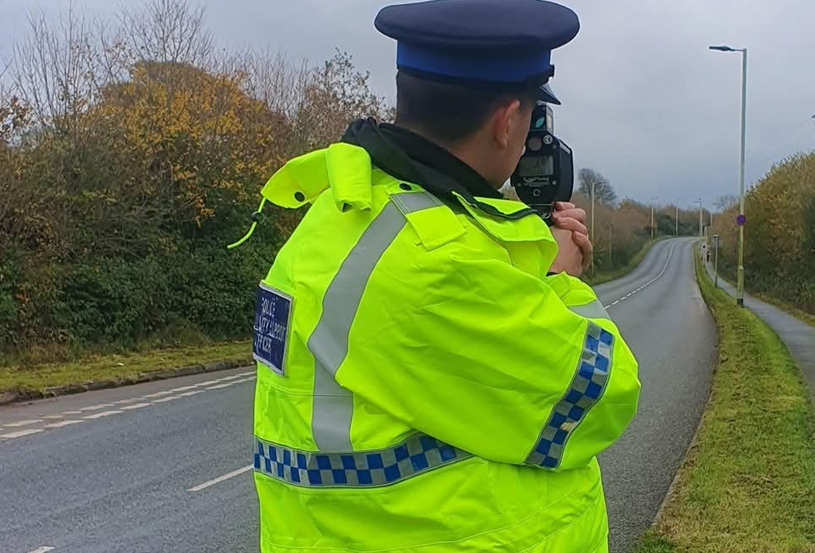
Above: Devon and Cornwall Police say speed and collision data has shown a need for the camera in the new location. Credit: Devon and Cornwall Police
READ NEXT: Arson suspected after speed cameras set alight in North Devon
James Anstee, the county council officer responsible for transportation, added: “This route has been camera-enforced for over 20 years, but the old speed camera at the top of Lakenham Hill had reached the end of its operational life, prompting a need to replace or remove it.
“The decision to replace this camera was based on traffic speeds and collision data. The new site was chosen because most collisions occurred between Heywood Road roundabout and the Churchill Way junction.
“This part of the route also had the highest number of recorded speeding vehicles, with typical weekly speeds exceeding 38mph in both directions of travel.
“A new site was needed to accommodate a camera that can enforce in both directions of travel and the new site was selected to provide drivers with greater visibility of the camera compared to the former site on the bend at the top of Lakenham Hill.
“The intention of these cameras is to reduce speeds and injuries, not to penalise motorists.”
Sergeant Owen Messenger heads up the Road Casualty Reduction team at Devon and Cornwall Police and is a well-known face on YouTube and TikTok, where he regularly collaborates with the George’s Car Media to educate the public about cars and road safety.
Sgt Messenger has previously debunked common myths and responded to frequently asked questions relating to speeding and speed cameras:
Why do you enforce speeding?
Speed is a major contributory factor in fatal and serious road collisions which we want to eliminate. Travelling too fast gives you less time to react if something happens and significantly increases your chances of sustaining serious or fatal injuries in the event of a collision.
The council are responsible for the installation of speed cameras in Devon.
With modern car technology and improvements to things like brakes, shouldn’t the speed limit be higher?
While driving technology has certainly progressed significantly in recent years, cars are still operated by humans who can mistakes. Sgt Messenger says: “The majority of collisions we attend are down to driver error and your reaction time is exactly the same in a modern car as it would be in a car from 30 years ago.”
Are these cameras collecting my data?
No. These speed cameras are Home Office Type Approved and use automatic number plate recognition to link a speeding offence to a vehicle. They cannot record driver or vehicle data for any other purpose.
Do the cameras only work on cars travelling in one direction?
No, bi-directional camera technology can accurately detect the speed of vehicles moving towards the camera and away from it.
Are speed cameras cash cows or revenue collectors?
Speed cameras are not about collecting money. The sole purpose of the cameras is to slow people down on the road and reduce the number of road traffic collisions.
It’s important to remember that driving is a privilege, not a right. When you sign up for a driving license, you sign up to follow by the rules – which are all there for your safety.
Sgt Messenger added: “If you are caught speeding and given penalty points and a fine, we don’t see any of that money. It goes straight to the national treasury, which decides how and where it is spent.
“If you are offered a driver education course, a percentage of this money does come back to the force, but can only be spent on improving road safety within the force area.”
If you have concerns about regular speeding in your area, please report them to your local council.
If you witness a vehicle being driven dangerously and believe there may be a risk to life, please always call 999.

Subscribe or register today to discover more from DonegalLive.ie
Buy the e-paper of the Donegal Democrat, Donegal People's Press, Donegal Post and Inish Times here for instant access to Donegal's premier news titles.
Keep up with the latest news from Donegal with our daily newsletter featuring the most important stories of the day delivered to your inbox every evening at 5pm.