
Bolton score against Exeter. Pic from PPAUK
Search


02 Mar 2026

Please allow ads as they help fund our trusted local news content.
Kindly add us to your ad blocker whitelist.
If you want further access to Ireland's best local journalism, consider contributing and/or subscribing to our free daily Newsletter .
Support our mission and join our community now.
To continue reading this article, you can subscribe for as little as €0.50 per week which will also give you access to all of our premium content and archived articles!
Alternatively, you can pay €0.50 per article, capped at €1 per day.
Thank you for supporting Ireland's best local journalism!


It's past 10 pm. She took the shortcut through the park, the one she's taken a hundred times. Halfway through, she realises she's being followed, footsteps, closer than they should be. She doesn't stop walking or turn around. She reaches into her pocket, opens her phone, and texts 999. No call, no voice, no sound. Just a message, sent silently into the dark. She registered for EmergencySMS months ago, on a friend's recommendation, and almost forgot she'd done it. Emergency services pick up her mobile network location, and help is on the way. She keeps walking and gets home safely. Most women either don't have that friend or don't know EmergencySMS exists.
Every year on International Women's Day, the same conversation plays out. Better lighting. Safer transport. More policing. And every year, women keep spending £420 on taxis just to get home safely, keep experiencing harassment at rates that haven't meaningfully shifted, and keep not knowing that the tools designed to protect them are already sitting on their phones.
The UK doesn't have an infrastructure problem. It has an information problem. And that distinction matters more than almost anything else being said today.
The Numbers Behind the Silence
The Office for Students Sexual Misconduct Survey 2025 surveyed final-year undergraduates across England. The numbers are not ambiguous.
33% of female students experienced sexual harassment
19% of female students reported sexual assault or violence
Only 13.2% of those who experienced sexual harassment in the last 12 months made a formal report
39.3% of those who did report rated the experience as poor
29.3% of students said they were not confident about where to seek support at all
Read those last two figures together. When women do report, 39.3% say the process was poor. And 29.3% didn't even know where to go in the first place. This is not a reporting problem. This is a systemic failure to equip women with the most basic information they need, before, during, and after.
Beyond campus, the cost is just as visible, just quieter. The average UK woman spends £420 a year on taxis specifically because she doesn't feel safe taking other options. That is money spent not on living, but on surviving the commute home. Safety anxiety isn't a feeling; it's a tax.
"Every year we see thousands of students, the majority of them women, moving to unfamiliar cities for the first time. They spend hours researching neighbourhoods, transport links, and accommodation safety ratings. But almost none of them arrive knowing about EmergencySMS, Silent 999, or what3words. The information gap isn't a minor oversight; it's the most preventable safety risk young women face, and it costs nothing to fix," says Ankit Aggarwal, VP Marketing, amberstudent.com.
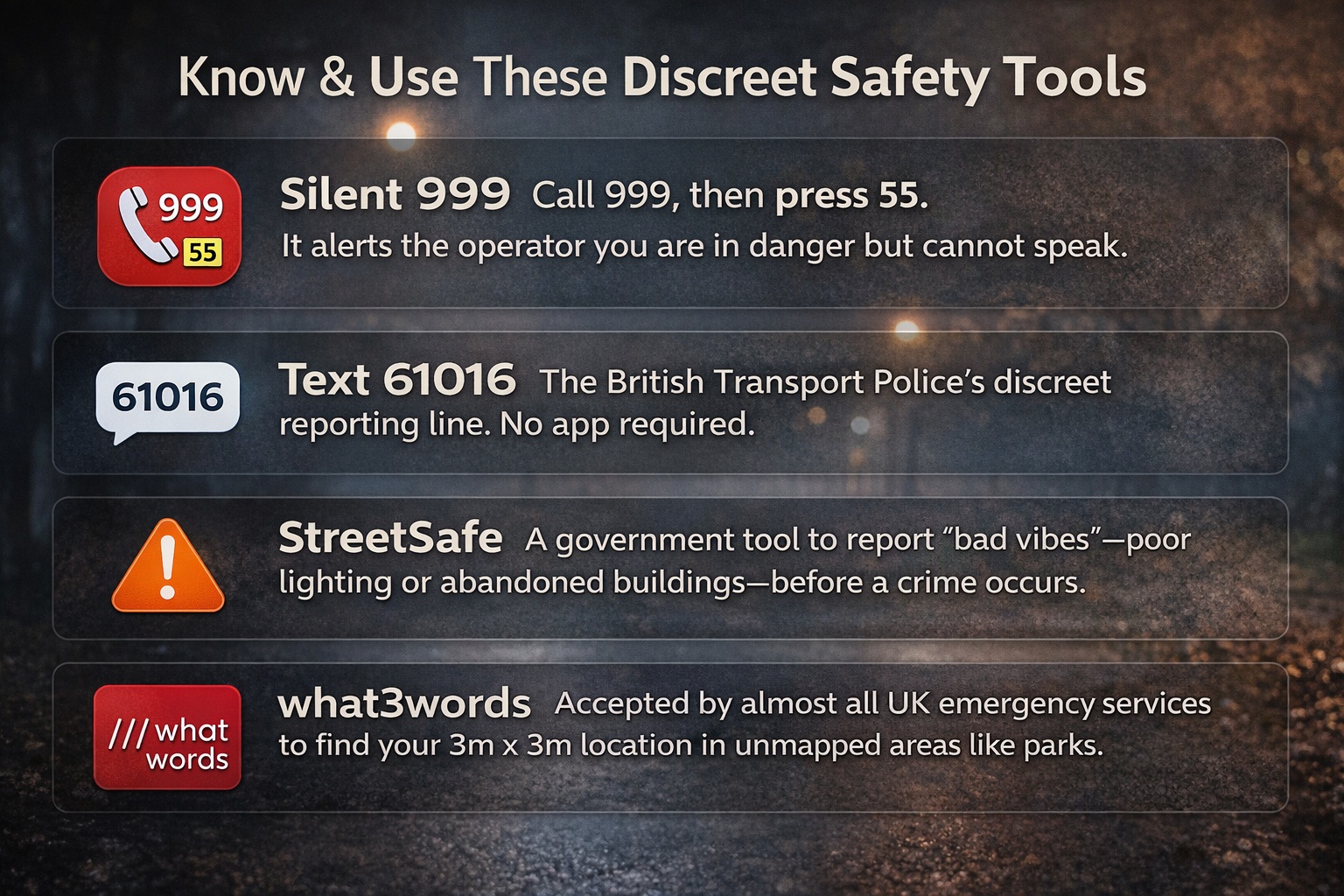
These tools exist. They work. They are largely free. The only reason most women don't use them is that nobody told them they were there.
EmergencySMS lets anyone text 999. Register once, text "register" to 999, and a voice call in a dangerous situation becomes unnecessary. It is equally built for anyone who cannot safely make a sound. It has existed for years. Most women have never heard of it.
Silent 999 goes further. Call 999 and, if you can’t speak, stay silent. The operator will usually ask you to cough or make a sound to indicate that you are there. On a mobile phone, you will then be prompted to press 55 so the call can be transferred.
It is important to note that pressing 55 applies to mobiles only. On landlines, calls are handled differently; if the operator hears background noise or suspects danger, they can still connect the call without 55 being pressed.
Text 61016. British Transport Police's discreet reporting line for trains and stations requires no phone call, no confrontation, no visible action. Nobody in the carriage knows anything has happened. There is a direct line to police response, sent silently from a pocket.
StreetSafe exists to report the places that feel dangerous, not incidents, but locations. The badly lit underpass. The bus stop where something happened. The shortcut no one should have to take. Every report feeds directly into place-based safety planning. It only works when people use it. Most don't know it exists.
What3words gives every three-metre square on earth a unique three-word address. In a park, on a footpath, somewhere impossible to describe to a dispatcher, what3words tells emergency services exactly where someone is in seconds. Multiple UK police forces and ambulance services now accept it. It could be the difference between being found and not being found.
The Wearable Layer of Protection
The question is no longer whether personal safety technology works, it's the version that fits a woman's life.
Keychain alarms; She's Birdie, the Ashley alarm are pull-pin devices that produce a piercing noise and strobe light on activation. They don't stop an attacker. They create noise, draw attention, and buy seconds. Seconds matter.
Discreet wearables do something different. Hollie Guard triggers an alert silently and can capture audio evidence. Flare and Callie are bracelet-style SOS devices that send a live location to chosen contacts the moment they are activated. Nobody nearby knows anything has happened. The contacts do.
For halls, hotels, or anywhere a woman is sleeping alone, portable door alarms like Birdie Box add a layer of protection that doesn't depend on the building's infrastructure or anyone else's decisions. No installation, no reliance on anyone else. None of this requires money that most people don't have. None of it requires technical knowledge. All of it requires one thing: awareness that it exists.
The Real Safety Investment
While International Women’s Day often focuses on long-term infrastructure and policy shifts, the immediate solution is already sitting in our pockets. The Safety Stack exists, but its effectiveness is capped by a systemic lack of awareness. True progress requires more than just reactive policies; it requires the active distribution of these life-saving tools. The infrastructure is ready; it’s time to make it visible.
Article supplied by Amberstudent.com

Subscribe or register today to discover more from DonegalLive.ie
Buy the e-paper of the Donegal Democrat, Donegal People's Press, Donegal Post and Inish Times here for instant access to Donegal's premier news titles.
Keep up with the latest news from Donegal with our daily newsletter featuring the most important stories of the day delivered to your inbox every evening at 5pm.