

North Devon councillor accuses government of treating region as 'residue' in council shake-up
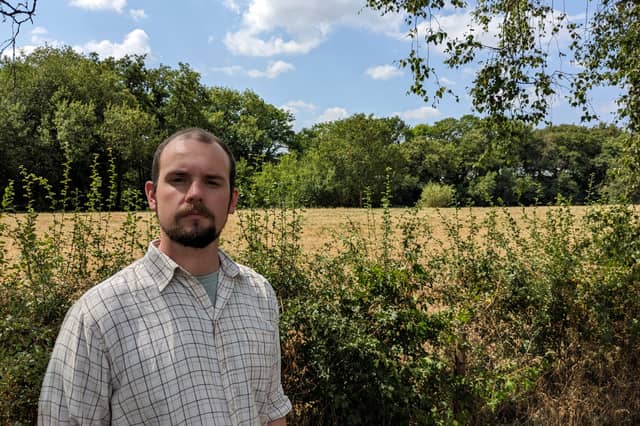

Cllr Ed Tyldesley has accused the government of imposing a council reorganisation model on North Devon that was rejected by both the district and county councils, after Exeter, Plymouth and Torbay were confirmed to expand under the plans.
A North Devon county councillor has hit out at the government's decision on local government reorganisation, accusing ministers of treating the area as "the residue left on a map after Exeter and Plymouth had taken what they wanted."
Councillor Ed Tyldesley, who represents Chulmleigh & Landkey for Devon County Council, issued the statement after it was confirmed on Thursday, July 16 that Plymouth, Exeter and Torbay will all expand to take on council services in surrounding areas, as part of the biggest overhaul of local government in the county for more than 50 years.
Under the changes, Plymouth will take in towns including Ivybridge and villages in the South Hams, Exeter will take over coastal towns including Exmouth and Dawlish, and Torbay will expand its boundaries.
The rest of Devon, from Holsworthy in the west to Seaton in the east, will be merged into a single new authority.
Cllr Tyldesley said the government had chosen a four-council proposal submitted jointly by Exeter and Plymouth city councils, which he said placed North Devon inside a large new "Devon Coast and Countryside" council covering most of the remaining county.
He said: "North Devon has been treated not as a community with a voice, but as the residue left on a map after Exeter and Plymouth had taken what they wanted." He added that even Torbay had not asked for the extra parishes it had been given control over.
He said the original proposal submitted by the two city councils had described the area they did not want to take on as "the rest of Devon," saying: "That phrase tells us everything we need to know about the thinking behind the process."
Cllr Tyldesley said North Devon District Council and Devon County Council did not support the model that was ultimately chosen. He said the two councils had instead backed a three-unitary alternative, alongside six other district councils, intended to create more balanced authorities, including a combined Exeter and Northern Devon council.
He said: "Instead, the model designed by the two cities has been imposed upon us by Labour ministers in Whitehall."
He argued this represented a "democratic deficit," saying: "Nobody in North Devon voted for this map. There has been no referendum. The Government consultation presented five competing proposals, but it was not a public ballot. Residents were allowed to comment, while the final power remained entirely with the Secretary of State." He said the government's decision letter had confirmed consultation responses were considered, but added: "It does not establish that this particular proposal commanded the support of people across Devon."
Cllr Tyldesley said the government's own decision letter had acknowledged that other proposals offered "less transition risk" and "more balanced populations," and had accepted that the chosen plan carried greater risk from changing boundaries and dividing existing services.
He said: "Ministers chose it anyway because they placed greater weight on allowing Exeter, Plymouth and Torbay to expand, build housing and pursue economic growth." He argued this represented "the central unfairness" of the decision, saying: "The opportunities have been concentrated around the cities, while the risks have been pushed outwards onto rural and coastal Devon."
He said the new authority covering North Devon would stretch "from our Atlantic coast across rural Devon to communities in the south and east of the county," and would be responsible for delivering social care, children's services, highways, public transport and other essential services "across a vast and disconnected geography."
He said: "Rural services do not become cheaper simply because our population is more dispersed. A care worker still has to travel along the same narrow lanes. A school transport route still has to cover the same miles. A pothole on an isolated road still has to be repaired. Residents in Ilfracombe, South Molton, Chulmleigh, Landkey, Barnstaple and all our villages deserve the same quality of service as people living within a few miles of a city centre."
He also pointed to what he described as challenges specific to North Devon that could be masked by countywide averages, including "serious coastal and rural deprivation, low wages alongside high housing costs, an ageing population, poor transport connections and communities where access to healthcare, education and employment can depend on long journeys."
He said Devon County Council's own public health analysis recognised that rural communities face higher transport and housing costs alongside limited access to services.
Cllr Tyldesley called for full transparency on the financial basis for the changes, saying: "We need to see the full financial assumptions, the cost of dividing staff, assets, contracts and services, and firm guarantees that North Devon residents will not be expected to pay more for less." He added: "Warm assurances about 'economic geography' will not mend a road, provide a care package, support a vulnerable child or keep a rural bus running."
He concluded: "This decision must not become an excuse for North Devon to be overlooked for another generation. We must demand fair funding, strong local representation and meaningful powers for our towns, parishes and communities. We must insist that services remain genuinely accessible from North Devon, rather than being managed remotely from offices many hours away."
He added: "Above all, we must reject the language and thinking behind 'the rest of Devon'. North Devon is not an administrative leftover. It is a distinct, proud and vital part of the county. Our communities deserve a voice equal to Exeter and Plymouth, and a system of local government built with us, not imposed upon us. The Government may have drawn the map, but it has not won the argument."