

David Fitzgerald: A train, a Carry On star and the Devon hero I walked past for years

From an unexpected encounter with his undertaker to a chat with a Carry On star, David Fitzgerald has had an odd couple of weeks. It ended with the discovery of a Devon hero who had been under his nose all along.
It has been an odd couple of weeks with a trip to London and hosting remembrance services for The Royal British Legion.
I must admit that I try to stay out of our capital as much as possible, having worked there for seven solid years. But I jumped on a train and headed for Paddington just as two named storms swept across the county. Needless to say, it was a delayed service both up and back from the big city, running through a hosepipe ban area, flooded as far as the eye could see. However, alighting at Paddington, I ran into a face I recognised from home but could not attach a name. We chatted…
“Haven’t seen you for ages,” was my opening line.
“Well,” he said. “I assume all your family are well… but give me a call if that is not the case.”
The penny dropped. He was the undertaker who had “dealt” with my parents and aunt in quick succession some years ago. We parted and I went to my function, a dinner in aid of The Grand Order of Water Rats.
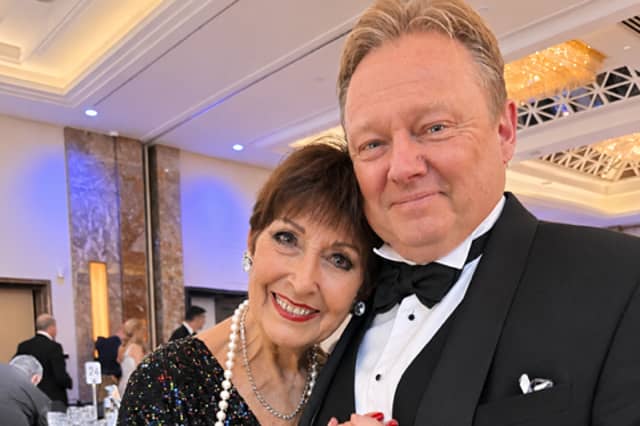
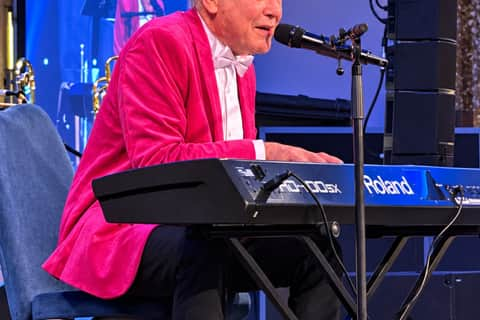
The next face I saw was a pure delight, an old friend who I first met in Torquay when she was appearing on stage at the Princess Theatre. Anita Harris is now one of the last stars from the Carry On film stable, having had roles in Carry On Doctor and Follow that Camel. It was lovely to catch up and later to be entertained by Mike d’Abo, ex of Manfred Mann and the man who wrote “Handbags and Gladrags” and “Build Me Up Buttercup”, just two of his massive hits.
The journey home was just as eventful, sitting opposite a crew member from the oldest team to row the Atlantic. We had plenty of time to chat over the events of ocean rowing as the rising waters of Somerset pointed to the fact that Devon was going to be even soggier.
But it did give me time to go through my notes for the upcoming Royal British Legion Devon Festival of Remembrance. I have hosted this event for the past fifteen years and in that time, I have been honoured to meet those who have served or paid tribute to those who have passed. I thought that I knew my military history pretty well, but this year I was surprised to discover yet another valiant Victoria Cross holder who was born in Devon.
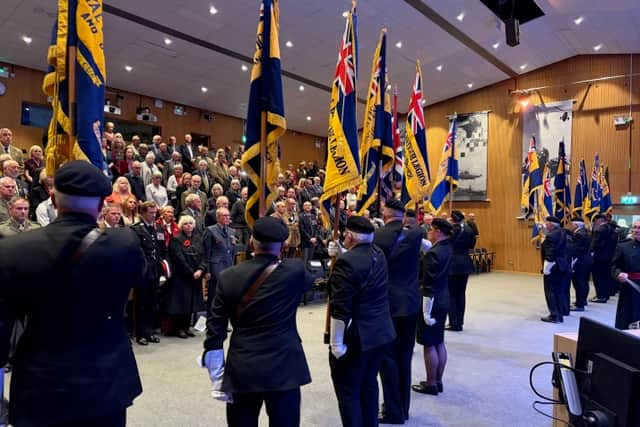
Our religious services are conducted by The Reverend Roger Carlton, who came up with the idea this year of paying tribute to those who enter the battlefield without weapons. Those who show the ultimate bravery under fire, unarmed and with just one aim, to save lives. As we had The Salamanca Band and Bugles of the Rifles playing at the concert, there was another link to this area. Band members will have seen service as medics and stretcher bearers; indeed, one was the stretcher bearer for Simon Weston in the Falklands.
Digging deeper into the subject, I discovered that there are over 300 members of the clergy, “padres”, in the modern day UK services. “Could we focus on one on the night?” was the request… and by sheer chance, perhaps the bravest and most decorated just happens to come from Devon.
His name was Theodore Bayley Hardy, and he was born in 1863 at Barnfield House in Southernhay in Exeter. He was ordained in 1898 and became an assistant master at Nottingham High School, teaching D. H. Lawrence at one point. He was 51 when war broke out in 1914 but volunteered at once. He was turned down as being too old. Eventually, in August 1916, he was accepted for army service as a Temporary Chaplain to the Forces, 4th Class and attached to The Lincolnshire Regiment.
And so, the story of incredible bravery begins…
He received the DSO in October 1917, rescuing men in front of enemy lines, returning at night for just one more… and, though under rifle fire at close range and with his left arm in splints, owing to a broken wrist, remained with the wounded man until able to escape.
Then followed the Military Cross in December 1917. For conspicuous gallantry and devotion to duty in tending the wounded under constant shelling and with heavy casualties. He continually assisted in finding and carrying the wounded and guided stretcher bearers to the aid post.
Then in July of 1918, the Victoria Cross. The citation read: “For most conspicuous bravery and devotion to duty on many occasions. Although over fifty years of age, he has, by his fearlessness and devotion to the men of his battalion in a quiet, unobtrusive manner, won the respect and admiration of the whole division.
“Some 400 yards in front of his line, he had found an officer dangerously wounded. He remained with him until he was able to get assistance to bring him in. During this time there was a great deal of firing, and an enemy patrol overran the position capturing men but not Baley or the injured officer.
“On a second occasion, when a shell exploded in the middle of the post, the Reverend Hardy at once made his way to the spot; under constant heavy fire, he rescued the buried men.
“On a third occasion it was believed that all the troops had withdrawn from a wood, but Chaplain Hardy emerged and asked for volunteers to help him to get a wounded man who lay by an enemy Pill Box. The man was too weak to stand, but between him and the serjeant they succeeded in getting him to safety. He then tended to the wounded, regardless of his personal safety.”
Hardy was appointed to the honorary position of Chaplain to His Majesty George V on 17 September 1918… a position he was not to see as he was wounded in action when again trying to tend to the fallen. He died a week later on the 18th of October 1918, two days before his 55th birthday.
The plaque in Southernhay simply reads: “The Reverend Theodore Bayley Hardy, VC, DSO, MC, Chaplain to the King.” It took me some time and wandering to find it as Barnfield House is still there but long since redesigned and blended into the area. That is my excuse as I have walked under the plaque for years and work in an office that overlooks it! The term “can’t see for looking” comes to mind.