

What happens to your dog on Bonfire Night? North Devon vet offers help and advice
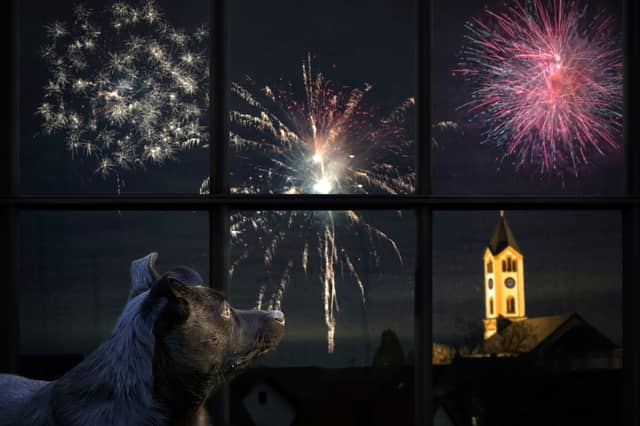

The time before and after November 5 can be a nightmare for some dog owners – a Bideford has explained there may be much more going on inside your pet than you realise and what you can do about it
Many dog owners dread the run in to Bonfire Night and after as their pets become terrified and stressed by the load noises overhead. A local vet has revealed how our canine companions are affected by fireworks - and what you can do about it.
People may wonder why one dog is scared of fireworks, shaking and barking, while another sleeps through November 5 with no apparent issues, but there is often more going on beneath and research with dogs has suggested there are genuine physiological changes taking place.
Bideford vet Kirsty Hambley, head veterinary surgeon at Torbridge Veterinary Centre, said: “We experience fireworks knowing exactly what they are, when we're likely to hear them and that they aren't a threat. Our dogs don't have that explanation.
“Imagine suddenly hearing an extremely loud, unpredictable noise when you don't know where it has come from. For some dogs, their body responds as though there is something they need to protect themselves from. These aren't dogs being naughty or overreacting. They can be outward signs of a very real fear response.”
Laboratory research involving dogs with a history of firework sensitivity found differences in their autonomic nervous system response when exposed to recorded firework sounds. Researchers observed animated behaviours - including hyper-alertness, searching for the sound, trembling, freezing, barking, hiding and attempting to run away.

But fear isn't always as obvious as a shaking dog. Subdued responses can also include pacing and restlessness, panting, quietly leaving a room, choosing an unusual place to lie in, refusing food and seeking attention. Dogs that display these behaviours may be less likely to get help, but that doesn't mean they aren't experiencing noise sensitivity.
No two dogs will react to fireworks in the same way. Evidence suggests the explanation may lie in a complex combination of genetics, age, health, previous experiences and learning.
Pain can also cause some dogs to become more sensitive to noise, which is why vet checks are recommended if a dog suddenly develops a noise phobia.
Kirsty added: “Owners sometimes wonder why their new puppy is frightened when their previous dog wasn't, or why two dogs living in exactly the same household react completely differently.
“Fear can also change during a dog's lifetime. So, if a dog suddenly develops a sensitivity to noise when it hasn't been frightened before, I'd recommend taking them to your vet.”
Kirsty’s six surprising facts about dogs and fireworks
1. Your dog can hear things you can't. Dogs can detect sounds from approximately four times further away than humans and can perceive higher-frequency sounds.
2. Firework fear creates a physical response in the body. It isn't simply behavioural. Research into firework-sensitive dogs has found measurable differences in autonomic nervous system activity after exposure to recorded firework sounds.
3. Fireworks aren't necessarily just about the bang. Fireworks create an unusual combination of unpredictable pops and whistles with flashes of light. The smells accompanying fireworks can also cause anxiety and stress in pets.
4. A dog's genes may play a part. There is intriguing evidence that susceptibility can have a genetic component. One recent study of standard poodles estimated genomic heritability for firework fear at 28 per cent in the population studied.
5. For some dogs, Bonfire Night can last much longer than one night. A study involving 1,225 dogs found that while three-quarters of fearful dogs had recovered by the following morning, 12 per cent took up to a week and more than three per cent took several weeks or even months.
6. Dogs don't just ‘get used to’ fireworks. Repeated exposure isn't guaranteed to solve the problem. Although some fear responses can diminish as an animal becomes accustomed, a significant proportion can instead become sensitised, meaning their response increases with repeated exposure.
What can you do? Kirsty shares some advice
* Owners can help frightened dogs by creating a safe place they can retreat to, closing curtains to reduce flashes, providing appropriate background noise and keeping dogs indoors when fireworks are being let off.
* Dogs should also be allowed some choice. Some may seek reassurance from their owners while others would rather retreat to a familiar hiding place.
* For dogs with established firework fears, longer-term approaches can include carefully managed desensitisation and counterconditioning. Veterinary assessment, behavioural support and appropriate anti-anxiety medication can be considered.
* Don't wait until Bonfire Night itself. If you know your dog struggles with fireworks, speak to your vet in advance so you have time to put the right support in place.
Owners who are concerned about their dog's reaction to fireworks can contact Torbridge Veterinary Centre - Bideford for individual advice by visiting https://www.cvsvets.com/south-west/torbridge-veterinary-centre-bideford