The Bird enclosure at Exmoor Zoo. © Copyright Shaun Ferguson
Search


14 Apr 2026

Please allow ads as they help fund our trusted local news content.
Kindly add us to your ad blocker whitelist.
If you want further access to Ireland's best local journalism, consider contributing and/or subscribing to our free daily Newsletter .
Support our mission and join our community now.
To continue reading this article, you can subscribe for as little as €0.50 per week which will also give you access to all of our premium content and archived articles!
Alternatively, you can pay €0.50 per article, capped at €1 per day.
Thank you for supporting Ireland's best local journalism!

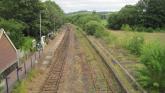
Yeoford station's active platform (left) contrasts with the abandoned and overgrown second platform (right), a visible sign of the Tarka Line's decades of underinvestment. © Copyright Nigel Thompson

At Eggesford station, one of the more extraordinary operational rituals of the modern British railway still takes place.
When two trains need to cross, the driver must pull a rope to lower the level crossing barriers and then physically pass a token, a baton, between drivers.
The token system, a method of ensuring only one train occupies a section of single track at a time, is a relic of nineteenth century railway working. It is not a common sight on today's network.
The scene at Crediton is equally striking. The train driver slows to a halt beside a salmon pink signal box where a signalman comes out to hand a metal token to the driver, a system no different now than when rail campaigner Tim Steer's great grandfather William Steer was the signalman in the same signal box in the early 1900s.
The Tarka Line is single track for almost its entire length.
Where two trains need to pass, they must wait at passing loops, bottlenecks that define the frequency and reliability of the entire timetable.
Board a train at Exeter St David's heading towards Plymouth or London Paddington and you step onto a modern, double-tracked railway. Turn north towards Barnstaple and you enter a different world.
Eggesford station is clearly well-used, yet it has no proper car park. A small forecourt at the front can take a handful of cars but spaces are gone quickly. Commuters have been left to improvise, abandoning their vehicles on surrounding country lanes just to reach the platform.
At King's Nympton station, campaigners want to see more stops as their community faces limitations that force residents to drive to Eggesford to catch a train. At Yeoford station, there is no footpath or station car park, and a second platform sits abandoned and overgrown. The Dartmoor line service passes through without any chance of stopping.
Tim Steer, chair of the Devon and Cornwall branch of Railfuture, does not mince his words. "In a nutshell, Great British Railways are not going to change anything in a hurry," he told the Gazette.
"In recent years, they have been trying their best, but lack of pre central government funding, they have been cut back to the bare bones, and this is why the old class of trains are on the line, they've been struggling to meet passenger demand."
These are not isolated examples, say those behind the campaign for the line's transformation. They are symptoms of a railway that has been systematically underfunded for decades.
For the full report, read the latest Gazette pages 14-15

Subscribe or register today to discover more from DonegalLive.ie
Buy the e-paper of the Donegal Democrat, Donegal People's Press, Donegal Post and Inish Times here for instant access to Donegal's premier news titles.
Keep up with the latest news from Donegal with our daily newsletter featuring the most important stories of the day delivered to your inbox every evening at 5pm.