

GWR delays Class 175 trains for North Devon route due to reliability issues
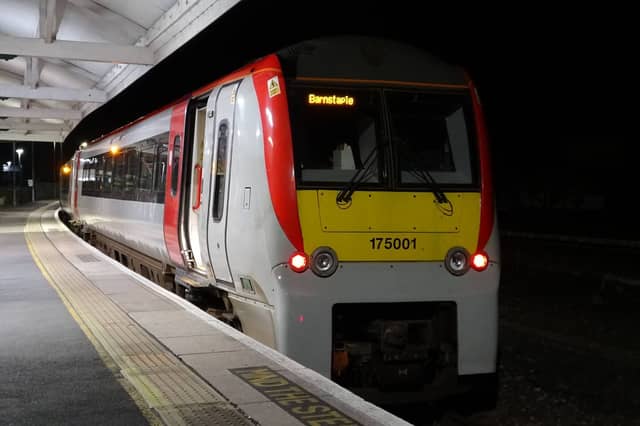

The introduction of higher-capacity Class 175 trains on the Exeter to Barnstaple line has been delayed until next year, with GWR citing persistent reliability problems with the fleet as the reason.
Long-awaited plans to bring higher-capacity Class 175 trains to the Exeter to Barnstaple line have been delayed until next year, after persistent reliability problems with the fleet forced GWR to introduce a temporary reduced timetable across its wider Devon and Cornwall network from today, Monday 7 September.
The Class 175s had been due to start running on the Exeter to Barnstaple route this year - a service upgrade long campaigned for by passenger groups and understood to have been in testing between Exeter and North Devon earlier this year. It is now understood that introduction of the trains on the route will not happen until next year, meaning further capacity for peak-time services that Barnstaple passengers had been hoping for will not materialise this year as planned.
The Gazette understands that a proportion of the Class 175 fleet has recorded reliability issues during testing, with the trains reportedly breaking down in unusual and hard-to-diagnose ways. GWR requires each unit to run a fault-free distance of 1,000 miles before it can be signed off; it is understood that any breakdown resets that mileage count back to zero, meaning a train must then run another 1,000 fault-free miles before it can be considered reliable enough for service. It is this pattern of faults, the Gazette understands, that has forced GWR to scale back its timetable across the wider network while the trains are brought up to standard.
Tim Steer, chair of the Devon and Cornwall regional branch of the rail campaign group Railfuture, confirmed the fleet's problems have pushed back the timescale for the campaign it has long run for improved North Devon services, but said the delay would not stop it continuing to press the case.
For passengers in Barnstaple and Okehampton who had been anticipating higher-capacity services, particularly at peak times, Mr Steer said the setback amounted to "yet another promise postponed."
The Class 175s are understood to have spent an extended period in what the industry refers to as "cold storage", stored out of use, largely in the open air and without the day-to-day maintenance a train receives while in active service, after being withdrawn by Transport for Wales, a factor Tim Steer pointed to in explaining the fleet's reliability problems: "Trains parked out in the open for 18-24 months can hardly have been expected to age well."
Wider timetable cuts across Devon and Cornwall
Beyond the North Devon delay, GWR confirmed that a number of weekday and Saturday services between Exeter, Plymouth and Penzance will be cancelled or revised over the coming months, with the changes weighted more heavily towards the Plymouth to Penzance section of the route than the Plymouth to Exeter section.
It is understood the step was taken because the Class 175s were not providing the reliability needed to operate the full timetable, with GWR aiming to give passengers more certainty, protect the reliability of the rest of the timetable, and reduce short-notice cancellations.
The Gazette has learned that changes are being uploaded to journey planners, posters are to be displayed at stations, and customers already booked on affected services will be contacted directly. GWR is also said to be looking at contingency road replacement services if needed.
What is changing
From Monday to Friday, five services will not run, including the 07:43 Penzance to Exeter St Davids, the 11:27 Exeter St Davids to Penzance, the 13:39 Plymouth to Penzance, and the 14:50 and 15:52 Penzance to Plymouth services. A further five weekday services will be revised, with some starting from different stations and others gaining additional stops, including at Hayle, Lostwithiel, Ivybridge and Menheniot, to help offset the withdrawn services.
Further cuts and revisions are planned for Saturday 12 September, and again for Saturdays between 19 September and 12 December. GWR has published the full list of affected services on a dedicated travel updates page on its website.
"Deep sense of frustration" - Railfuture
Tim Steer, chair of the Devon and Cornwall regional branch of the rail campaign group Railfuture, said passengers and GWR alike would be frustrated by the disruption, but backed the operator's decision to act early.
"We can only share the deep sense of frustration of both GWR and its customers at the predicament which they find themselves in," Mr Steer said. "We recognise that this outcome will be a big disappointment for many passengers. Nevertheless, we welcome the fact that GWR has taken decisive action to address the problems with the Class 175 fleet while relatively few are in service and the impacts on the timetable are less severe than they would have been at a later stage."
He commended GWR for adding extra station calls to other services to help offset the effect of the withdrawn trains, but was clear that responsibility for the situation lay beyond the train operator itself.
"This dilemma is by no means of GWR's own making; we are most certainly not 'shooting the messenger', and there are other actors in the wider rail industry who should be taking a long hard look at themselves for their part in this debacle," he said. "Trains parked out in the open for 18-24 months can hardly have been expected to age well."
Looking ahead, he said Railfuture was awaiting the Government's Rolling Stock Strategy and noted that the replacement of GWR's regional diesel fleet had "at least progressed as far as the DfT's commercial pipeline." He added the group's voice to calls for central government to speed up progress, so that GWR could within the next few years offer trains "fit for the second and third quarters of this century" with a dependable and comfortable customer experience. Railfuture, he said, would also look to newly-devolved regional bodies in the South West to consider what complementary role they could play in supporting any infrastructure investment required.
Fleet background
The 26 Class 175 trains are owned by rolling stock company Angel Trains and are leased to GWR. The units were built by Alstom in Birmingham between 1999 and 2001 and were previously operated by Transport for Wales, before being withdrawn from service there and replaced by newer Class 197 units, with GWR agreeing the lease for the fleet in March 2025.
In August 2025, Alstom signed an eight-year, roughly £75 million technical support and spares agreement with GWR to support the fleet's reintroduction, with maintenance to be carried out from GWR's Laira depot in Plymouth. Alstom said at the time that the trains were expected to enter passenger service "later this year" following recommissioning and driver training, and would operate on regional routes including Exeter St Davids to Penzance, Barnstaple and Okehampton.
The Class 175s are the first GWR fleet to use Alstom's HealthHub monitoring system, which draws on data such as speed, temperature and location transmitted from each train every 30 seconds, intended to flag developing faults before they affect passenger services.
The North Devon Gazette has approached Transport for Wales for comment.