

North Devon MP meets Rail Minister in bid to protect Tarka Line from winter disruption
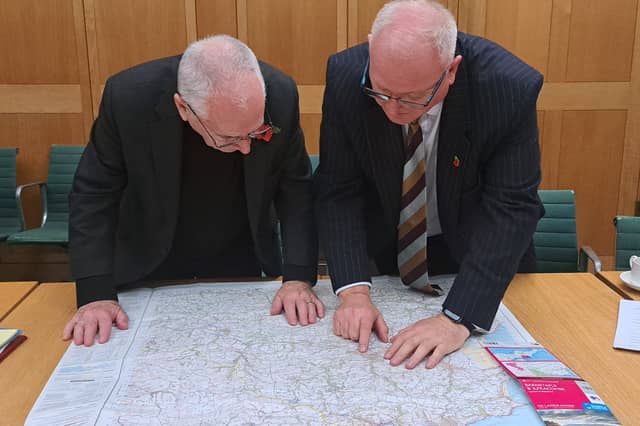

North Devon MP Ian Roome has met with Rail Minister Lord Hendy to press for long-term investment in the Tarka Line, which has been repeatedly disrupted by flooding and storm damage, with passengers facing significantly longer journeys and businesses affected by the prolonged closures.
North Devon MP Ian Roome has taken his campaign to protect the Tarka Line from further winter disruption directly to the Government's Rail Minister, after a devastating start to the year saw the railway shut for more than three weeks, disrupting education, livelihoods and vital journeys between Barnstaple and Exeter.
The Liberal Democrat MP met Lord Hendy in Westminster on the evening of Wednesday, November 11, to press for long-term investment in the railway, which was brought to a standstill for 24 days earlier this year after Storm Chandra caused extensive flood damage.
His intervention comes as the line faces another winter, with the Met Office warning of an increased likelihood of wetter and stormier conditions during late autumn and early winter.
Following the meeting, Network Rail has agreed to operate a Rail Head Treatment Train (RHTT) between Exeter and Barnstaple twice a week, alongside the Okehampton route, and invest £1 million in anti-scour technology, including specialist cameras to monitor vulnerable bridges.
The RHTT is a specialised maintenance train used primarily during autumn to clean fallen leaves and debris off railway tracks and restore wheel-rail adhesion.
The measures are intended to improve reliability and reduce the need for closures, but they come against a backdrop of mounting concern over the railway's ability to withstand increasingly severe weather.
For passengers along the Taw Valley, the consequences of repeated disruption have extended far beyond delayed trains.
In February, the Exeter and North Devon Colleges Group told the North Devon Gazette that the Tarka Line had been out of service for nearly 10 per cent of the college year.
“We share the frustrations of our learners,” a spokesperson said at the time. “More must be done to ensure transport infrastructure in the South West is protected. To have the line down for 10 per cent of the year is simply unacceptable.”
The repeated loss of services has disrupted attendance, extended journeys and, in some cases, prevented students from accessing education altogether.
For families without access to a car, the railway can provide an essential connection to further education, employment and healthcare.
The scale of the problem became clear in January when Storm Chandra brought prolonged heavy rain to already saturated ground across Devon.
Floodwater washed away stone ballast supporting the track between Exeter and Crediton, while bridges and viaducts were submerged.
Services were suspended on January 27 and did not fully resume until February 20, leaving communities between Crediton and Barnstaple without their usual rail connection to Exeter for more than three weeks.
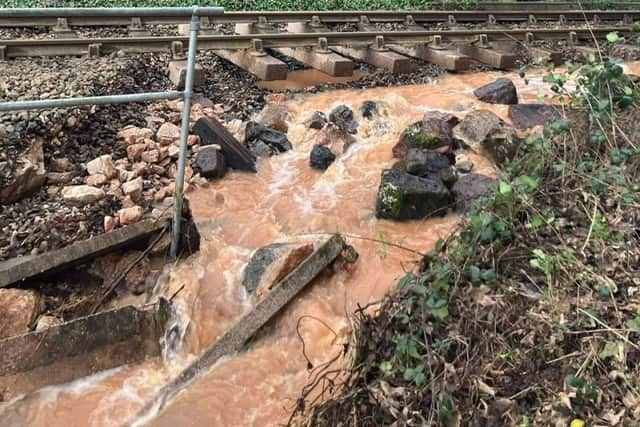
Replacement buses and coaches were provided, but passengers faced significantly longer journeys.
The disruption caused by Storm Chandra came just two months after flooding in November 2025 forced the closure of three railway bridges, bringing services between Barnstaple and Exeter to a halt.
The effects have also been felt by businesses reliant on the railway.
In an earlier Gazette investigation, the owner of Station Masters Café described how trade collapsed during the prolonged closure, with takings falling to approximately £18 on one day and the business temporarily closing because it could no longer afford to remain open.
The disruption has continued beyond the winter storms.
In September, GWR introduced additional coaches to help accommodate students travelling to Exeter College after the start of term, acknowledging that demand on a key morning service exceeded the railway's capacity.
The operator said the branch line could not accommodate longer trains because of platform restrictions, while additional train services were not possible because the route was already at capacity.
Then, in October, a fallen tree near Crediton caused another suspension of services, leaving students trying to return home from Exeter facing further uncertainty.
The repeated incidents have intensified calls for a more resilient railway.
The Met Office's State of the UK Climate 2025 report, published in July, found that the UK's winter half-year, from October to March, was 13 per cent wetter during 2016 to 2025 than during 1961 to 1990.
It also found that the occurrence of exceptionally wet months during that period had approximately doubled compared with the earlier baseline.
Separately, the Met Office said in September that the unusually strong El Niño could increase the likelihood of wetter and stormier conditions across the UK during late autumn and early winter.
However, meteorologists stressed that seasonal forecasts cannot determine exactly when or where severe weather will occur.
The longer-term outlook adds to concerns about infrastructure built in an era when extreme weather presented different challenges.
Against that backdrop, Mr Roome has been pressing the Government, Network Rail and Great Western Railway for improvements through his Future Proof our Railway campaign.
More than 3,500 people signed his petition calling for investment, which was presented to Parliament in February.
According to figures cited by the MP, stations on the North Devon Line recorded an additional 600,000 passenger entries and exits between 2018/19 and 2023/24, exceeding pre-pandemic levels.
However, the largely single-track railway has relatively few passing places, limiting opportunities to increase the frequency of services.
Mr Roome said: “I was glad to press the case for investment in the Tarka Line with Lord Hendy. We’ve had several long periods of disruption over the past year, leaving students and commuters stranded. We desperately need a railway fit for the future.
“GWR comes into public ownership next month, but that must be the start, not the finish. Passenger numbers have grown significantly, and a mostly single-track railway with so few passing places can’t cope. I was out on the tracks with Network Rail earlier this year, and it’s clear we can’t rely on short-term fixes alone. We need joined-up planning for more capacity and for bad weather.
“In 2027, the last thing any of us want is more cars on already busy roads because people have lost faith in the railway. I will keep pushing the Government and Network Rail until we have a line that is protected against the weather and ready for the future.”
The meeting follows earlier parliamentary scrutiny of the railway's vulnerability to flooding.
The Gazette reported in May that Mr Roome was seeking a meeting with Lord Hendy after discussions in the House of Lords highlighted the potential for advanced monitoring technology to reduce disruption caused by flooded bridges.
During severe flooding, engineers can be prevented from inspecting bridge foundations until water levels have fallen sufficiently, prolonging closures even after the worst of a storm has passed.
Anti-scour technology is designed to help monitor erosion around bridge foundations, potentially allowing engineers to assess risks more quickly.
Network Rail has now committed £1 million to such technology, including specialist cameras, although it has not yet been confirmed which bridges will receive the equipment or when installation will be completed.
The twice-weekly railhead treatment service will address a different problem, helping reduce the risk of slippery rails caused by fallen leaves and other contamination.
Network Rail and GWR previously told the Gazette that work was under way to improve drainage, vegetation management, weather forecasting and flood monitoring ahead of winter.
However, their responses did not establish a firm timetable for permanent improvements to the stretch of railway worst affected by Storm Chandra.
Great Western Railway is due to enter public ownership on December 13, a change Mr Roome believes should mark the beginning of further improvements rather than the end of the Government's involvement.
For North Devon's students, workers, businesses and patients who depend on the railway, the test will be whether the latest commitments can prevent another prolonged period of disruption.
After a year in which passengers have repeatedly been forced to find alternative ways to travel, confidence in the line's reliability remains a central concern.