

Do we fully value Exeter Airport? - Tim Jones
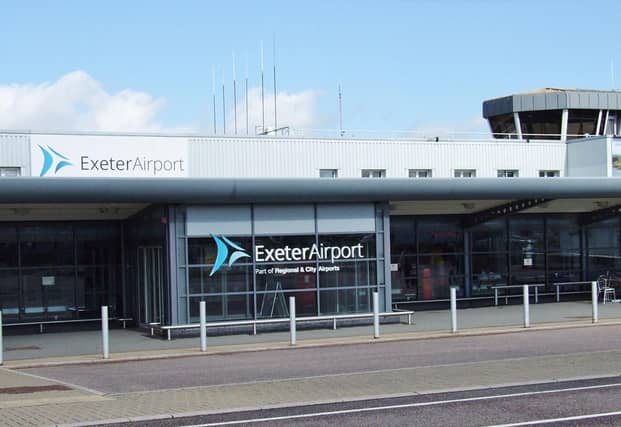

A critical component of a successful regional economy is good connectivity. Without this, we simply cannot function. Life has been made a little easier since Covid, as we have now learnt how to work remotely. What used to be a mystery trip for many of us
A critical component of a successful regional economy is good connectivity. Without this, we simply cannot function. Life has been made a little easier since Covid, as we have now learnt how to work remotely. What used to be a mystery trip for many of us – a Teams or Zoom call – has quite simply liberated large parts of our region, particularly in rural areas.
We are still learning how we can best use this amazing technology but are still heavily reliant upon good physical infrastructure.
The extraordinary collective effort that has resulted in the upgrade to the North Devon Link Road (even in its slightly dumbed down format) will be a huge boost. By far and away the most important element for a successful economy is a good and reliable road network.
The trick will be to ensure that when the current road improvement programme is completed, that we use this to best effect and ensure that all those who want to visit or do business with us are fully aware that this journey will be a lot easier. I have seen in the past too many examples of road improvements, such as this, which have been poorly promoted and have only resulted in people being able to travel out of a region quicker, rather than being encouraged to visit. I will return later to my views on how we can use this investment to enhance our economic prospects, there is however no doubt that we should plan ahead for this and that there is no time like the present.
Rail travel is something we should not ignore. It probably has a greater impact to benefit social and community activities. Business use is relatively limited and has been badly influenced by the irregularity of the service, the huge escalation in ticket prices and, most recently, the unpredictability caused by rail strikes – what an own goal. Look however to the importance of the Tarka Line, which facilitates an enormous number of otherwise impossible journeys for many in our region who are being educated.
This subject becomes more tricky when we look at our airports. There is a strong perception that flying is one of the principle reasons for Co2 emissions. The truth, in fact, is that this makes a marginal difference to Co2 outputs and that, by comparison with domestic housing Co2 outputs, it represents a very small percentage of the problem. That said, we should not ignore this, all aspects of business need to act responsibly as part of climate change challenges and the airport industry needs to take responsibility to clean up its act.
The issue of how valuable the airport is to Northern Devon is something worth debating. At a practical level, the convenience of flying is indisputably better than other transport modes. I used to visit regularly the Norwich area, which was a five plus hour drive and an overnight stay. This became a very pleasant 50 minute flight from Exeter to Norwich airport courtesy of Flybe. The benefit this brought to a business relationship was powerful. I also personally was a regular user of the link between Exeter and London City Airport. Many very valuable discussions resulted from this and there is no doubt that this helped in a small way to improve the understanding in Whitehall about the power and potential of the North Devon economy.
It was a matter of great sadness when Flybe ceased to trade. This cut off a crucial commercial pipeline. This, together with Covid, dealt a savage blow to the viability of Exeter Airport. The passenger numbers dropped from around 1 million per year to around 100,000 per year. We are extremely fortunate that the owners of the airport were prepared to play a long game and not to panic or enter into a fire sale.
This financial catastrophe is proving to be a potential golden renaissance for the airport.
It has given them the chance to take on board the challenge of green flying. The airport hosted one of the first commercial electric (battery powered) commercial flights in the UK. It is continuing with this agenda. There are some inspiring developments not just around electric powered planes but also aviation fuel which is derived from bio-diverse sources. Green fuel and electric planes will be common place in the very near future. This should restore our faith in airports.
It is interesting that this comes at a time when other airports around the country and internationally are beginning to see a revival in passenger numbers. The latest figures tell us that the UK’s eight biggest airports now have plans to fly almost 150 million more passengers a year.
This is the equivalent of 300,000 extra jumbo jets. These figures sound ambitious but they have been hatched around the need to be green. Most of these airports have found that they would be able to absorb this growth without the need for extensions or new runways.
It is perhaps surprising that they could handle 387 million passengers annually, a more than 60% increase on the 240 million travellers who used these airports in 2019. I should state again that all of these are still expecting to be able to reach Net Zero Greenhouse Gas Emission targets by 2050. It is of course inevitable that the vast majority of this growth will be at our national airports.
At least a third of this will be from London Heathrow. Against these predictions, Heathrow would be handling 142 million passengers a year, compared with the 81 million they handled pre-Covid. This is a hugely good news story. Growth predictions like this mean that the owners of airports and the airlines who operate from them will be keen to invest.
There is therefore a great prospect that many new routes will be opened as a result of this, which will encourage both inbound and outbound trade.
It is my judgement that Northern Devon needs to recognise the value of a successful airport on its doorstep. It is reasonable to say that those who are concerned about the pollution flying causes, can now be more relaxed about this industry getting its act together. The message here is, I think, simple.
We need to think more proactively about Exeter Airport being a key component for growth of the North Devon economy. It should feature more highly in our thinking and appear more regularly as part of the promotion for this region. I would greatly welcome a healthy debate on this subject.