Train services between Exeter, Okehampton and Barnstaple are being suspended tonight due to high winds. GWR Class 158, No. 158798. © JThomas, Creative Commons Licence [Some Rights Reserved].
Search


09 Jan 2026

Please allow ads as they help fund our trusted local news content.
Kindly add us to your ad blocker whitelist.
If you want further access to Ireland's best local journalism, consider contributing and/or subscribing to our free daily Newsletter .
Support our mission and join our community now.
To continue reading this article, you can subscribe for as little as €0.50 per week which will also give you access to all of our premium content and archived articles!
Alternatively, you can pay €0.50 per article, capped at €1 per day.
Thank you for supporting Ireland's best local journalism!


Should Auld Acquaintance Be Forgot…
Even though 3I/ATLAS has now passed its closest point to the Earth and is now speeding away from the Solar System, the internet conspiracy theorists are still harping on about it. As its designation informs us, it is only the third object from interstellar space (that is, from outside of our Solar System) to be observed and so it was expected to provide some unusual observations and data.
One thing the internet chatter warned us about was the close approach and what that might mean for us on the Earth. What this chatter never told you was that. At its closest approach to the Earth, 3I/ATLAS was still about six times the distance of the Sun away from us. So, about 558 000 000 miles.
Clearly a comet, albeit an unusual one, originating from outside our Solar System, it displayed many features in common with known Solar System comets such as: varying size and colour of the coma (like Comet Kohoutek in 1973), forward-facing jets or spikes (known as anti-tails) (like Comet Arend-Roland in 1956) numerous jets or tail-like outbursts (like Comet De Chesaux of 1744 which displayed six tails in a fan-like structure) and a rotating nucleus (like Comet Churyumov-Gerasimsnko which the ESA probe “Philae” landed on in 2014). What made 3I? ATLAS unusual is that it displayed all of these properties during its passage around the Sun.
The NASA/JPL space probe, Voyager 1 is set to reach a milestone distance from the Earth during 2026. The probe, which was launched in 1977 and is still operational, returning data from interstellar space, will reach the distance of 1 Light Day later this year. This measurement is defined as the distance light travels in one Day at a speed of 186,000 miles per second (300 000 kps) and equates to, approximately, 16 427 104 723 miles. That is, Sixteen Billion, Four Hundred and Twenty-seven Million, One Hundred and Four Thousand, Seven Hundred and Twenty-three miles. Naturally, Voyager 1 is the most distant man-made object. At its current rate of travel it would still take the probe nearly 80 000 years to reach the very next, nearest star to the Sun, if it were travelling in the right direction, which it is not.
The Star Chart
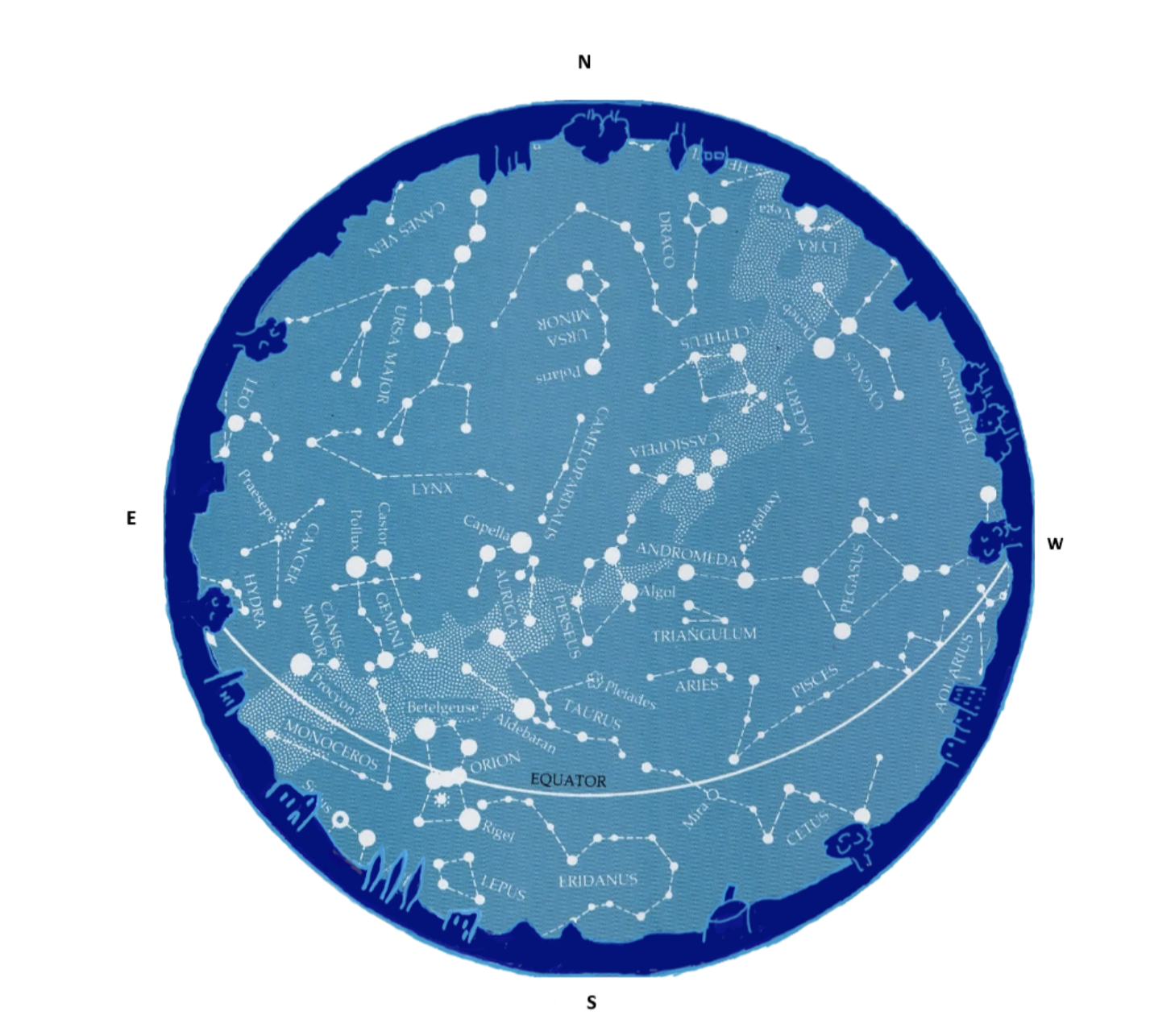
The sky looked like the chart on January 7 at 9pm and will look like it again on January 21 at 8pm. And then four minutes earlier on each successive night e.g. 8.56 on January 8. To use the chart, hold it above your head whilst facing South so that you can look directly from the chart to the sky.
Skynotes
Please note all times given in this article are in GMT and as the clocks have changed that is the current time.
Sun: At the start of the month there is just 8 hours of daylight but as January progresses the length of day will increase by 1 hour and 15 minutes. On 3rd the Earth will be at its closest point in its orbit to the Sun: it is Winter in the Northern Hemisphere because the North Pole is tilted away from the Sun, spreading its energy over a greater surface area.
Mercury: Mercury is not visible this month..
Venus: Venus is not visible this month.
Mars: Mars is not visible this month.
Jupiter: Jupiter is visible all night long and reaches a good elevation as the night progresses. The giant planet lies in the constellation of Gemini and reaches its opposition (closest point in its orbit to the Earth, and opposite the Sun in the sky). The Galilean moons can be seen with a good pair of binoculars or a small (bird-spotting) telescope. DSLR images of the planet will also pick up the moons. The cold winter skies (if they are clear) give a much clearer and steadier image in a telescope or binoculars making observations much more satisfying. On January 3rd the Full Moon will lie close to Jupiter, and on 31st the nearly Full Moon will again lie close to the giant planet.
Saturn: Saturn rises at about 18.00 and is seen against the background stars of Pisces in the south-west. The ringed planet reaches an elevation of about thirty degrees making it more easily visible in the dark winter skies. The crescent Moon is close to Saturn on 23rd.
Uranus and Neptune: Uranus is visible almost all night long throughout January and is seen against the background stars of Taurus. It lies below the Pleiades star cluster. At magnitude 5.8 it is visible in binoculars. Look for a tiny greenish disc compared to the pinpoints which are the stars. Neptune is seen against the background stars of Pisces in the South-West and very close to Saturn. The crescent Moon on 32rd is close to both planets. At magnitude 7.9 it will require large binoculars or a small telescope to find it. Neptune displays a smaller and truly blue disc compared to that of Uranus although it will appear only as a bluish star to most small instruments
Meteor Shower: The only meteor shower this month occurs from 1st to 6th January. The meteors seem to radiate from a point near the end of the handle of the Plough but is known as the Quadrantids meteor shower as it is named after a now defunct constellation, Quadrans Muralis.
The Full Moon occurs on January 3rd with Last Quarter on 10th, New Moon then follows around midnight on 17/18th and First Quarter occurs on 26th .
Data supplied by Dale Giles, Torbay Astronomical Society
Diary Dates
The next meetings of the Torbay Astronomical Society 70th Anniversary Season will be held at Torquay Boys Grammar School, Shiphay Manor Drive, TQ2 7EL.
On January 8th Torquay Boys’ Grammar School old boy, Professor David Southwood of Imperial College, who is the former Head of Science Missions at the European Space Agency and a former President of the Royal Astronomical Society, will give a talk entitled “From Torquay to Titan, and Beyond: Memories from a Career in the Cosmos”.
Then, on 22nd an observational evening will take place (weather permitting) when members will be delighted to provide views of the objects discussed in this article.
In the event of bad weather, short talks and videos will be presented alongside informal discussion and an opportunity to get to know the Society.. Both meetings begin at 7:00pm for a prompt 7:30 start. For details contact the Secretary TAS on astrosecretary@gmail.com . Visitors and prospective members especially welcome.

Subscribe or register today to discover more from DonegalLive.ie
Buy the e-paper of the Donegal Democrat, Donegal People's Press, Donegal Post and Inish Times here for instant access to Donegal's premier news titles.
Keep up with the latest news from Donegal with our daily newsletter featuring the most important stories of the day delivered to your inbox every evening at 5pm.