National survey ranks Plymouth highest for drivers unwilling to change to EVs (Image- RawPixel CC0 1.0)
Search


15 Feb 2026

Please allow ads as they help fund our trusted local news content.
Kindly add us to your ad blocker whitelist.
If you want further access to Ireland's best local journalism, consider contributing and/or subscribing to our free daily Newsletter .
Support our mission and join our community now.
To continue reading this article, you can subscribe for as little as €0.50 per week which will also give you access to all of our premium content and archived articles!
Alternatively, you can pay €0.50 per article, capped at €1 per day.
Thank you for supporting Ireland's best local journalism!

In 1856 London’s Victoria and Albert Museum bought an unusual pendant jewel. It cost the V&A £21 and was probably sold by the Cary family after being discovered in the grounds of Torre Abbey.
The elaborate pendant would have hung from a chain and dates from the 1540s. As Henry VIII’s Dissolution of the Monasteries abolished the Abbey in 1538 it isn’t a piece of jewellery the abbots would have made or owned. It also has an inscription in English rather than Latin, telling us that the owner believed that we need not fear death as our sins are taken away by Christ's resurrection.
The pendant features a skeleton in a coffin and is a memento mori, meaning in Latin 'Remember you must die'. Such jewellery was popular in the sixteenth and seventeenth centuries, and included mourning rings, lockets, brooches and pendants such as the Torquay example. These depicted skulls, bones, and coffins, and often included messages and the names of the departed picked out in precious metals and enamel.
Not far away from the Abbey at the top end of Lucius Street is the Greek Orthodox Church of St Andrew, originally known as St Saviour’s. The church was constructed in its present form in the fourteenth century on the site of an earlier Norman chapel, but as a church may date as far back as the late sixth century.
Amongst the 690 recorded graves in the churchyard is a headstone featuring a skull and crossbones. Local folklore once held this to be the grave of a pirate. It is, however, another memento mori.
The memento mori, whether in jewellery, architecture or art, is intended to remind us of the inevitability of death. The origin is said to come from a Roman custom. When a general returned after a great victory on the battlefield, he would parade through the streets in a chariot receiving the applause and cheers of the crowd. To avoid becoming too arrogant, a slave would remind him of his mortality by whispering to him: “Look behind, remember that you are a man.”
The expression then developed with the growth of Christianity. Several passages in the Old Testament urge a remembrance of death; in Genesis God tells Adam: “You are dust, and to dust you shall return.”
Taking Christianity’s emphasis on Heaven, Hell and the salvation of the soul, the memento mori came to feature in funerary art and architecture from the medieval period onwards. As in our Torquay examples, the most common motifs were skulls accompanied by bones.
All history has a soundtrack and the memento mori can be heard in the lyrics of folksongs and chants of early music. It was especially popular with those facing death during the recurring bubonic plague pandemics from the 1340s onward. They reminded people to lead sinless lives as they awaited Judgment Day.
If this all seems a bit gloomy, until the twentieth century remembering one’s own death was not something negative, but rather an encouragement to lead a virtuous, good and meaningful life. The intention was to encourage Christians to stop wasting their lives pursuing other people’s goals, hoarding material possessions, or worrying about trivial matters. There were far more important considerations.
Skulls have fascinated people for thousands of years. They are one of the most recognisable symbols across the world and still warn us of poison, danger, or hazardous materials.
How far this goes back in our history we don’t know. However, the Dumnonian Celts lived in the Bay up until the seventh century; ancient Greek and Roman sources document Celtic headhunting practices and we have material evidence of ritual head worship.
In medieval England displaying a skull became a warning and a way to encourage good behaviour. They were used to decorate defensive palisades and seen on pikes at London’s Traitor’s Gate. Human remains left in gibbets at Torquay’s Gallows Gate, Newton Abbot’s Forches Cross and Brixham’s Windy Corner were intended to have the same deterrent effect.
One of the most well-known depictions of the skull is on the iconic pirate flag. It is believed that the emblem was borrowed from the flags of the North African barbary corsairs that operated under a green flag with a skull symbol. From the seventeenth century European pirates were using a similar death’s-head to identify themselves, the image designed to epitomise buccaneering ruthlessness and their challenge to law and order.
The pirate flag would have been familiar to local folk as for centuries North African marauders plagued Torbay alongside pirates from France, Holland, Spain, and even from other parts of the British Isles. On occasion, freebooters actually used Torbay as a base. One notorious villain was John Nutt, who operated from his headquarters in the Bay with support from local folk. For over three years during the early seventeenth century he was a major force, being known to take a dozen vessels a week.
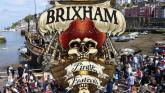
We remember this long association through Brixham’s Pirate Festival with its skull and crossbones motif.
Sometimes truth is stranger than fiction, which brings us to the myth of the crystal skull. During the mid-nineteenth century there was a real interest in ancient cultures. This public enthusiasm increased when a number of crystal skulls were supposedly discovered in South America. The proposal was that a ‘primitive tribe’ couldn’t have created something so exquisite so they must have been made by the gods.
If this seems familiar, you might have seen the, not very good, 2008 Indiana Jones and the Kingdom of the Crystal Skull movie where crystal skulls were featured.
The Torquay link is that the most famous of the crystal skulls ended up in Torquay.
In the 1920s an explorer called Frederick Mitchell-Hedges claimed to have discovered a crystal skull in a Mayan ruin. He called it the Skull of Doom and said it was “at least 3,600 years old and according to legend it was used by the High Priest of the Maya when he was performing esoteric rites. It is said that when he willed death with the help of the skull, death invariably followed”.
In 1958 Frederick and his adopted daughter Anna moved to Shaldon and, for a time, the artefact was kept in a house on the Newton Road. After Frederick’s death Anna toured with the Skull exhibiting it on a pay-per-view basis. Invited ticket holders, for example, could see the artefact at Torquay’s Imperial Hotel for a charge of £20.
According to Anna the skull had by then acquired additional powers was able to cause visions and cure cancer. She also claimed to have used its magical properties to kill a man, and that she saw in it a premonition of the assassination of JFK. Anna passed away in 2007 at the age of 100.
So, is the Skull of Doom or any of the other skulls occult, or even alien, artefacts of unimaginable power?
Probably not. None of the skulls have been authenticated as pre-Columbian in origin, and none come from documented excavations. Microscopic inspection indicates that the skulls were carved with high-speed, modern, diamond-coated tools in the mid-nineteenth century or later, almost certainly in Europe.
We’ll probably always be fascinated with skulls. Indeed, they seem more common now than ever. In the past, skulls were the province of a minority of people, such as rebels or heavy metal, goth and punk enthusiasts; but now skulls appear on everyday jewellery, bags, clothing, and in tattoos. Being so commonplace they may have now lost much of their mystery, intrigue, darkness, and danger.
On the other hand, perhaps something does remain of the ancient meaning of memento mori: “Remember you must die”.

Subscribe or register today to discover more from DonegalLive.ie
Buy the e-paper of the Donegal Democrat, Donegal People's Press, Donegal Post and Inish Times here for instant access to Donegal's premier news titles.
Keep up with the latest news from Donegal with our daily newsletter featuring the most important stories of the day delivered to your inbox every evening at 5pm.