

THE DEVON DATA CAMPUS: A LETTER TO LOCAL RESIDENTS

From Richard Hardy, Xlinks Project Director
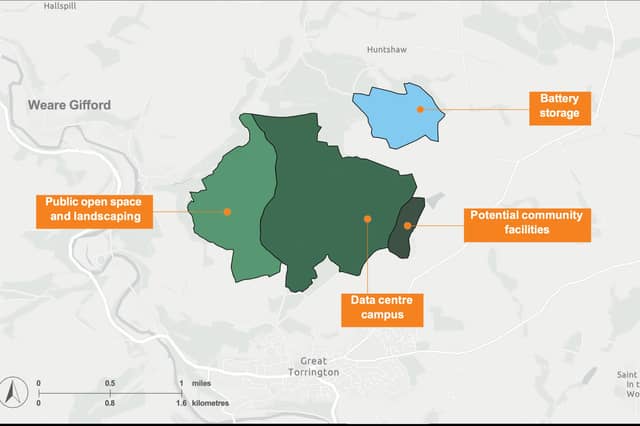
Xlinks is proposing a data campus on land between Great Torrington, Huntshaw and Weare Giffard. It would consist of an AI data centre and an energy storage system.
We have not yet submitted our planning application: we will first be conducting a public consultation. A separate consultation will be undertaken later by Torridge District Council.
We are aware that there are already strong views locally. Before we draw up our planning application, we want to listen to as many local views as possible, and provide information to answer people’s questions.
Given the high level of interest, we are extending the consultation period to create more time for engagement. We now plan to submit our planning applications in the new year.
As part of this, we are moving the Public Information Days (PIDS) to after the summer (which will avoid the holiday period), to create more time for us to talk with local residents in advance. The new PIDS dates will be announced once they are confirmed, to provide as much notice as possible.
In the meantime, we will be running smaller, informal sessions in the local area to gather feedback and to answer questions.
If you would like to share your thoughts in other ways, please contact [email protected] about the data centre or [email protected] about the energy storage system. You can send us a letter to Devon data campus, Freepost SEC NEWGATE UK LOCAL or call us on 0800 888 6922.
We are aware that some local landowners are being approached with views about the scheme – please instead come direct to us using the details above. Local landowners are not representatives of the project.
We know a project of this scale will raise questions – we’ve aimed to answer some below and will add more to our website.
We want to ensure we are listening to you and providing answers to your questions. We are keen to contribute effectively and ensure the campus creates a positive long term legacy. We invite you to work with us to achieve this.
QUESTIONS & ANSWERS
How does the planning process work? Separate applications for the data centre and energy storage system will be submitted to Torridge District Council. Before we submit, we are consulting locally to help shape the design. Once submitted, the Council will publish it and invite comments, typically over 21 days. A planning officer or committee will assess and decide on the application against planning policy and consultation responses. The data centre is submitting for outline planning only at this stage: a detailed application would follow later, which would go through the same process as above.
How many jobs will be created? We expect 650- 1,200 permanent jobs, 2,000 -3,500 during construction. In addition, there will be more jobs created in the supply chain.

How would the data centre create jobs? AI data centres host modelling work and need dedicated 24-hour teams to ensure they run reliably. This data centre will require a skilled and diverse team, from electrical engineers to maintenance staff.
Would the jobs created go to local people? Employees who are locally rooted stay in their roles longer, which helps retain skill, knowledge and a good culture. The campus will work with local education partners on skills and training and run job fairs to maximise local recruitment. Local supply chain sessions will be run for local businesses on opportunities to partner on construction and operation.
What other benefits would the Devon data campus bring? Alongside local income such as business rates, the campus would include a community benefit package worth tens of millions of pounds, made up of: i) direct grants to local groups, clubs and initiatives; ii) on site facilities; iii) wider area investment, determined by the district council.
Is there a data centre already up and running where all these benefits have been achieved? Yes, a great example is the START Campus in Sines, Portugal. You can find out more at startcampus.pt
Why does AI matter? It is the engine behind many everyday services and is already helping to solve important problems in lots of organisations, e.g. +4 million NHS patients have already had faster lung cancer diagnoses or all clear.
Why do we need UK-based AI data centres? To meet AI demand, the UK needs more computing capacity. Today, the UK relies on AI data centres abroad, which creates data security risk, and that the UK doesn’t benefit from the job, and investment they bring. The NHS and Police are just two of the organisations who are bringing data back onshore.

Why site an AI data centre here? There is a ‘Goldilocks’ climate here: not too cold, not too hot, just right – reducing the need for heating and cooling, cutting energy and water use. There is capacity available to connect into the National Grid at this location. The area also has strong fibre connectivity.
Would the data centre cause local energy bills to go up? No. There will be no impact on local electricity supplies or prices. The data centre will use power from a different system to local homes.
What about local wildlife? We want to protect and enhance the environment. We are also obliged to ensure there is more nature than before (a 10% biodiversity net gain vs today) and to maintain that over the campus’ life. We intend to create a nature plan aligned to the North Devon Biosphere’s world-leading approach.
Would the campus consume lots of water from local waterways? No. We plan for the site to be self-sufficient, recirculating water to absorb heat (like a car radiator), topped up from collected rainwater.
Would it discharge into local waterways? No, there’d be no discharge into the Torridge or any waterway. The site would contain any firefighting runoff on site, in the unlikely event that this is needed. We would work up plans with input from Devon and Somerset Fire and Rescue Service and other statutory bodies.
Would the energy storage system pose a fire risk? Energy storage site fires are very rare. In fact, less common than in other non-residential buildings. The scheme will be subject to strict regulations. We would work with the Fire & Rescue Service on a fire plan so that, in the unlikely event of a fire, any incident on site would be contained, so that there is no threat to the health and safety of local residents.
Would the campus be noisy from outside its boundaries? No. There would be strict limits set as part of the planning process, which would be enforced across the campus’ lifetime. We will also design in noise buffers, like landscaping and trees. The noise will be monitored to ensure it doesn’t breach limits.
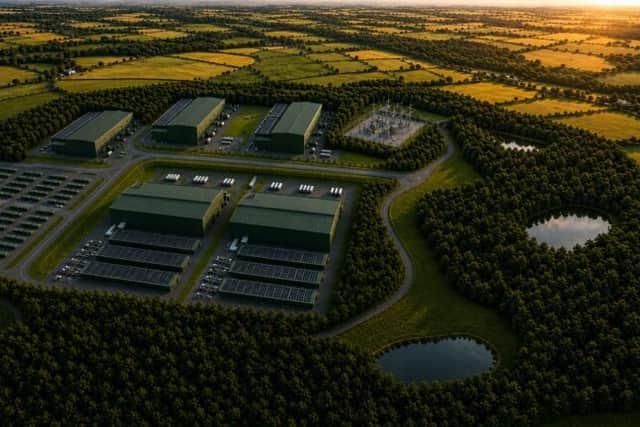
Would I be able to see the data centre? Yes, from certain viewpoints, however the landscape of the site helps us to minimise this, along with existing woodland screening. We will create more natural screening with planting and landscaping.
How would construction be managed? A construction management plan, which must be agreed with the local authority, would cover traffic movements, noise, dust, light controls, and working hours on site. The plan must show what measures are being taken to minimise any impacts on the community.
Would the campus be powered through the Morocco-UK Power Project? There are no current proposals for this. The campus would be powered through the national grid (via Alverdiscott). The Morocco-UK Power Project is a separate project that remains on pause. There is a possibility of a renewables interconnection as part of a later phase (from Morocco or elsewhere, e.g. Ireland), but that would require a separate planning process.
What is the timeline for the project? Subject to planning consent, enabling works are provisionally planned for 2027/28, with construction starting in 2028/29, with the energy storage system complete by the end of 2030. The data centre construction timeline depends on the availability of computing components but is likely to run in phases across a multi-year period.
Who is Xlinks? Xlinks is a British company that specialises in renewable-energy based projects. You can read more about Xlinks at xlinks.co