

'Thrilled' to see National Trust's plan for North Devon - David Worden

Sometime ago NDC declared a climate and biodiversity emergency and efforts to restore or transform local spaces with a variety of native wild flowers, trees and plants is really outstanding news. Not only is it good for the environment and wildlife but it
Sometime ago NDC declared a climate and biodiversity emergency and efforts to restore or transform local spaces with a variety of native wild flowers, trees and plants is really outstanding news. Not only is it good for the environment and wildlife but it creates an even more beautiful and interesting place for people to live, work or visit.
So I was thrilled to learn recently of the National Trust’s plans to create a huge wild flower meadow across North Devon. I understand that nationally in about the last hundred years the equivalent of 4.5 million acres of species - rich grassland has been lost with only one or two per cent remaining.
This has come about because of the development of land for housing and also changes in farming habits. I know from being brought up on a farm we used to have lots of wild flowers including cowslips, foxgloves, columbines and daisies which are less common now. In addition many of our gardens have changed being less full of plants for food, with less being left for long grasses etc.
As a result many individuals, communities and organisations have in recent times been making an effort to help reestablish wild flowers on road side banks, waste ground and meadows in our countryside.
North Devon Council has adopted the policy of ‘no mow May' in order to let various varieties grow on land which we own or look after. Outside of our council offices at Brynsworthy we have an area where wildflowers are flourishing and at the height of the flowering season it looks really attractive.
In my town of South Molton, next to the Community Gardens, we have a meadow where we are endeavouring to encourage wild flowers. Last month the judges in the South West in Bloom competition rated it as ‘thriving’ so progress is being made.
Why are wild flower meadows important to the environment? The Royal Botanic Kew Gardens, Director Richard Deverell has said, 'British wildflowers are under threat and therefore so are the pollinators they feed. Not only is it heartbreaking to lose the beauty and colour these native flowers give the UK landscape, but the plight of pollinators has a very real impact on the food we eat ourselves.'
Wild flower meadows provide shelter and food for important pollinators including bees. There are over 250 species of bee in the UK and they play a vital part in supporting the ecosystem.
If wild flower meadows vanish so do pollinators and many insects. This brings a decline in the wildflife that eat insects, such as birds, hedgehogs and bats. Bees are in particular decline in the UK and they play a vital part in supporting the ecosystem. We are fortunate in South Molton in having the Quince Honey farm and bees from there frequent my garden and pollinate my runner beans, fruit etc.
What I haven’t seen in large numbers in recent years are butterflies. It is reported that since 1976, overall butterfly numbers have declined by around 50 per cent. I used to see lots of peacock and red admiral butterflies on flowers in my garden but they have not been so evident recently and I would love to see them thriving again.
The more diversity we have in our natural habitats, then the more bees, birds, animals and other insects there will be so that is why I am delighted to hear about the plans of the National Trust in our area.
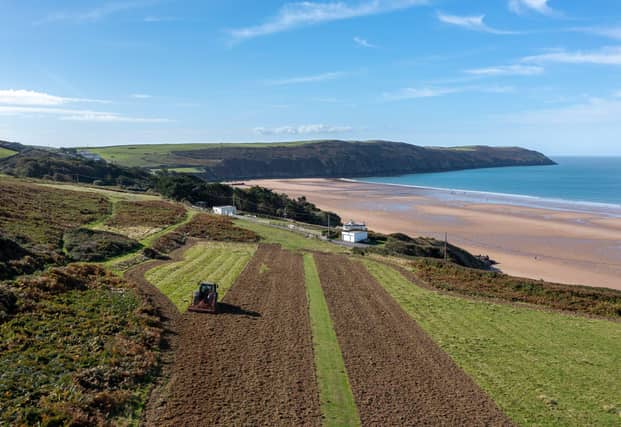
It will be a fantastic enhancement to our biosphere. I understand that 1.3 tonnes of wildflower seed has already been planted and the target is an amazing 25,000 hectares by 2025. The project under the coordinator, Josh Day plans to sow seed across 70 miles of the north Devon countryside by the end of this decade.
The mixture of different types of wildflowers will form meadows on sites around Arlington and Woolacombe. At Arlington, bird’s-foot trefoil and knapweed seeds are among the varieties which have been sown and at Woolcombe species such as kidney vetch and viper’s bugloss. Hopefully this will also help us see more blue butterflies flourishing and especially the small blue which is scarce in this part of the UK.