

The ‘flying barn door’ - Britain’s largest eagle to be reintroduced to Exmoor
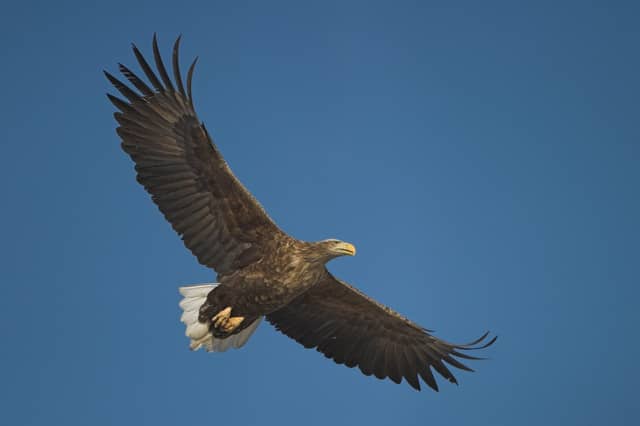

White-tailed eagles or sea eagles, with wingspans up to 2.5 metres will be reintroduced to locations across Exmoor from this summer
The once-extinct white-tailed eagle – Britain’s largest bird of prey with an eight-foot wingspan – is to be reintroduced to parts of Exmoor from this summer.
Today (Wednesday, May 13) Natural England approved a bid to release more of the iconic raptors on Exmoor, following a successful reintroduction on the Isle of Wight in 2019.
Nicknamed the ‘flying barn door’ because of their huge wingspan, white-tailed eagles, also known as sea eagles, became extinct in England in 1780 and disappeared from the British Isles altogether by 1918.

Above: White-tailed eagles love fish but also eat gulls, crows and other corvids. Credit: Dan Sayers
Working with Exmoor National Park Authority, they will to release up to 20 young eagles on Exmoor over the next three years. Releases will take place at both locations this summer.
Exmoor was chosen after tracking data from the Isle of Wight releases showed the moor had been frequently visited by several of them and provided suitable habitat. It is known the eagles formerly bred along the wild Exmoor coastline.
White-tailed eagles prefer fish, but will take a variety of other prey including birds, such as corvids and gulls, small mammals and carrion.
The diet of the eagles released on the Isle of Wight has shown they love seasonally abundant marine fish, such as grey mullet. They also prey gulls, carrion crows and other corvids.

Above: A white-tailed or sea eagle spotted soaring over Exmoor following their release on the south coast. Credit: Jacqui Leeming
Ali Hawkins, senior ecologist with Exmoor National Park Authority, said Exmoor’s large areas of coastal woodland provided the perfect habitat for them.
She added: “Their reintroduction to the national park is an exciting next step in delivering more for nature recovery and we’d like to thank everyone connected to the project.
“We are committed to continuing to work with farmers and other stakeholders, to support them in adapting to this species fledging on Exmoor once again. We hope that people will be lucky enough to see one of these incredible birds in the coming years.”
All of the released birds are fitted with satellite tags so the project team can track their location and study their progress.
Roy Dennis OBE, founder of the Roy Dennis Wildlife Foundation, said: “White-tailed eagles were once a common sight in England but were lost centuries ago. This project is reversing that situation and I am delighted that we will be able to release additional birds this year and boost their numbers in the wild.
“It is exciting to be able to play a part in restoring these birds back to their former home and to see how well they are fitting into the English landscape. We will continue to work closely with a range of organisations as we enter this next phase of this exciting project.”
There has been some controversy over their release, with some Scottish farmers saying they have lost lambs to the huge birds since they were reintroduced.
The National Farmers Union (NFU) has met regularly with the project team and is calling for ongoing support in response to farmers’ concerns.
David Chugg, NFU south regional board chair, said: “The NFU has been working with the project partners for over a year to ensure members’ concerns were represented and accounted for.
“Through our engagement we have looked to gain a longer-term commitment for the management of these birds, to ensure that farmers are not burdened with the cost of managing their reintroduction.
“We know there are a wide range of views on the reintroduction of white-tailed eagles. Some farmers are keen to see these birds back in the landscape.
“However, many farmers do have concerns about the potential risks that white-tailed eagles could bring to farm businesses on and around Exmoor, especially around livestock predation.”
The government’s Environment Secretary Emma Reynolds said: “The return of white‑tailed eagles to Exmoor is a powerful example of this government’s commitment to reversing the decline of nature and protecting it for generations to come.
“As part of our new ‘Wild Again’ campaign, we are investing £90million into species recovery, marking the largest ever government investment to directly support threatened wildlife.”