

Revolutionising the fashion industry - Plastic Free North Devon
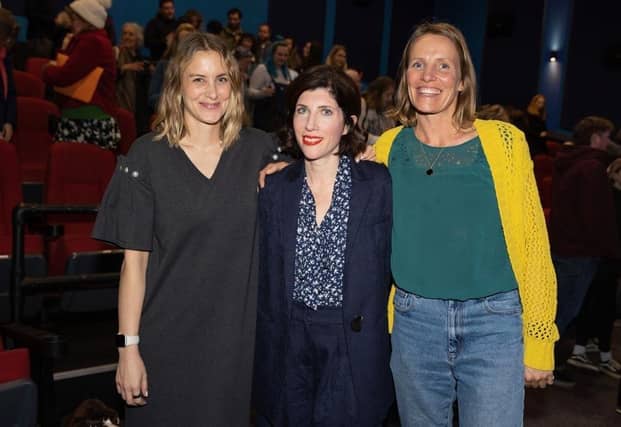

I was honoured on behalf of PFND to be asked to sit with producer Becky Hunter as part of her premiere screening of Fashion Re-Imagined at Scott Cinemas in Barnstaple, moderated by activist, surfer and founder of ‘rise fierce’, Sophie Hellyer Becky invit
I was honoured on behalf of PFND to be asked to sit with producer Becky Hunter as part of her premiere screening of Fashion Re-Imagined at Scott Cinemas in Barnstaple, moderated by activist, surfer and founder of ‘rise fierce’, Sophie Hellyer
Becky invited us to represent the work we are doing with our growing network of Repair Cafes in North Devon. A local solution for our communities to not only recycle and repair garments, electricals and bikes but provide a cross-generational mixing space to enjoy a warm space, tea and cake,
The Film
The film itself follows the journey of fashion designer Amy Powney on her quest to make the high-end brand ‘Mother of Pearl’ sustainable right the way through the supply chain. Her journey is driven by an unwavering passion to revolutionise the fashion industry. At the time of filming, she was considered a renegade.
“There’s no handbook on how to make a brand sustainable, but I wanted to know from start to finish where our product was grown or derived, who was making it and the social impacts along the way. I’ve journeyed to find the best factories, suppliers and farmers who care about the planet and its inhabitants as much as we do.” - Amy Powney
The best thing for me about this film, and in fact any environmental filmmaking, is that it builds knowledge that ultimately empowers us to make more informed decisions about how we participate in our beautiful, mainly blue world.
Director Becky uses Amy's journey to highlight just how difficult it is to effect change down the supply chain and speed at which WE as citizens of the planet, not just consumers, need to change our habits.
But in order to effect change at the speed needed the whole fashion industry must transform their current model and provide their customers the opportunity to purchase products that are good for the planet and humanity.
Fast Fashion - The Negative
Cheap synthetic materials like polyester derived from fossil fuels, are phenomenally cheap to produce. These shed micro-plastics into our environment when we wash and wear them.
Did you know that a shocking 35 per cent of all micro-plastics originate from textiles AND have even become embedded into our food chain?
Disturbingly, the production not only props up the fossil fuel industry, it also contributes to global warming on a massive scale. Did you know the fashion industry produces about 10 per cent of annual global carbon emissions, which is more than all maritime shipping and international flights combined…(wtf!) And…the fashion's emissions of harmful greenhouse gases are projected to grow by more than 50 per cent by 2030.
Ultimately, we need to reduce our rate of consumption, not simply exchanging one product for another ‘greener’ product, which leads nicely on to the subject of greenwashing…
Greenwashing - what is it?
Misleading or deceptive publicity disseminated by an organisation so as to present an environmentally responsible public image.
The vast majority of us can't afford Mother of Pearl clothing, so what are the alternatives for guilt free shopping?
Whilst there are great sustainable fashion brands and resources (I’ve linked to some below), there are many high street and other brands selling us on their ‘sustainable’ lines.
More often than not these huge retailers are diverting our gaze to a very small section of their business for good PR so that they can continue to produce unethically and unsustainably en masse.
We advocate for upcycling and repairing your clothes as a first option, then looking to buy second hand where possible, and only then carefully choosing brands that are sustainable throughout.
Film director and editor Becky taught us to ask the following three questions before making a purchase:
Do I really need it? Can I really love it? Will I wear it for years to come?
The Positives
The second-hand clothing industry is set to outpace the fast fashion industry by 2023 with sites such as Vinted and Depop.
While many of the facts were very frightening, the film also gave us hope that fashion CAN be re-imagined and we must all play our part. Every time you spend money, you vote for the kind of world you want to see.
North Devon Repair Cafes
We are now running four Repair Cafes throughout North Devon. So far we have them in Ilfracombe, Braunton, Barnstaple, Landkey and soon, South Molton and Combe Martin. There are also regular repair cafes being run in High Bickington and Atherington and Bideford by other community groups.
The aim of the cafes is to reduce waste by helping people to repair items that may otherwise be thrown away, to support people during the cost of living crisis (donations are welcomed, but there is no pressure or expectation), and to create a diverse and generational welcoming community hub. It also aims to teach people new skills that can be taken home and shared too.