

Plastic Free North Devon’s Ocean Explorers making more than just a splash
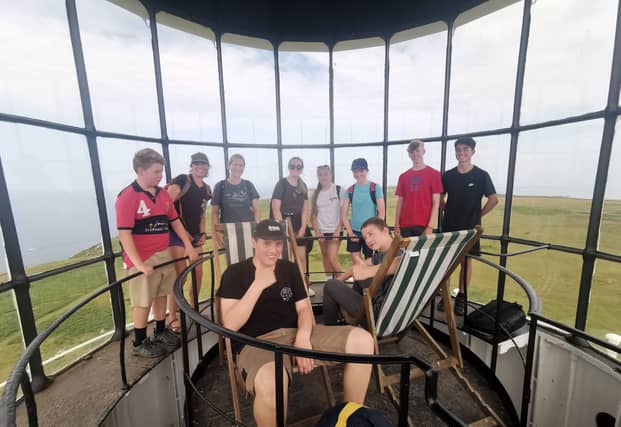

Here at Plastic Free North Devon, education underpins our mission to protect and improve our environment, and over the last year we have been evolving and piloting our Ocean Explorer outreach with some very promising and exciting results. What started ou
Here at Plastic Free North Devon, education underpins our mission to protect and improve our environment, and over the last year we have been evolving and piloting our Ocean Explorer outreach with some very promising and exciting results.
What started out as an idea to connect people with nature and inspire them to want to protect it, quickly morphed into nature connection VR experiences shared with members of the public at local events that summer – and now, three years on, encompasses so much more.
Thanks to funding from the North Devon AONB we have been able to create our own VR experiences specifically rooted in our local environment, from seal diving off Lundy Island, to rock pooling at Lee Bay, and exploring the journey of the River Taw from estuary to sea.
We’ve taken those VR experiences into more varied settings including a local nursery, youth centres, and libraries along with community festivals and events.
Bringing the VR experiences closer to home after the pandemic struck a chord – we originally used underwater footage of tropical reefs and sharks in far flung waters – and we found people connecting more with the films and realising that what we do on a local level directly impacts the health of our oceans, and our own health in turn.
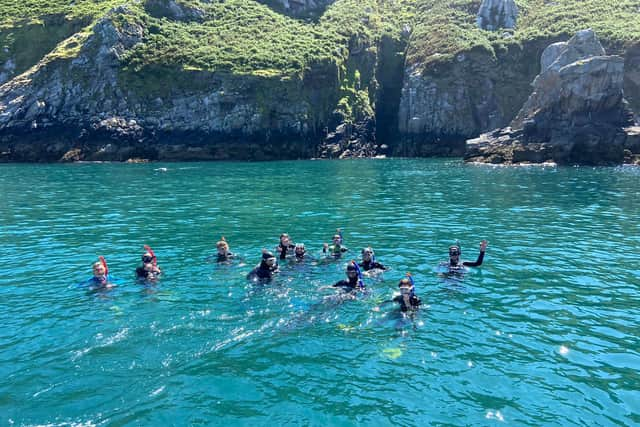
With additional funding from the North Devon Unesco Biosphere, made possible by the Government’s Community Renewal Fund, we have been able to develop this project even further.
We now have schemes of work for Key Stage 2, 3, and 4; have taken another 18 local Year 9 children on nature connection adventures to Lundy; and are continuing to deliver assemblies and follow up pop up outreach for year 9 and 10 pupils to experience our VR and talk to us about advocacy, opportunities, and careers.
Despite funding for this particular aspect coming to an end, we hope to maintain the momentum into the autumn term.
We have also been piloting a project with groups of Year 8 students from Ilfracombe Academy over six week blocks across the spring and summer terms, exploring some of our key local habitats, including taking them on ‘rockpool safaris’, microplastic hunting, sand dune exploring, birdwatching and mud-wallowing on the Taw estuary, tree planting, to an organic farm, and to Ilfracombe’s Aquarium and Earth Repair Shop.
These students have then gone on to sign up to volunteer with us over the summer as Ocean Explorer Ambassadors, taking their new-found passion for the environment and what they’ve learned back into their schools and out into the wider community.
Working with a small group over a sustained period of time clearly has its merits.
We all get a chance to get to know each other, establish a team dynamic and to discuss and build on the themes and subjects we cover.
There is a real opportunity here for a lasting impact when compared to a one-off experience.
Despite living in a Unesco Biosphere Reserve and Area of Outstanding Natural Beauty, the fact is that economic barriers and poor public transport provision mean that a large number of local children will not necessarily have had the opportunity to spend time in the amazing nature right here on our doorstep.
And we’re on a mission to change that!
Each step of the way, we have found young people connecting on a deeper level and becoming more and more engaged.
So why does this matter?
Research into the impacts of learning in the natural environment (LINE) underline what we have seen.
LINE has direct educational, physical and mental health benefits for children along with indirect benefits ranging from social to financial.
Various studies have demonstrated that education with a strong environmental focus and in a natural setting improve educational outcomes, attitudes to other children, awareness of science and environmental subjects, behavioural outcomes and social cohesion, health benefits, and staff morale.
Where education projects include cross-community and inter-generational mentoring then the benefits extend beyond the school to the wider community.
The keystone to all of this is harnessing the potential of education as an opportunity to connect our children and young people with nature on their doorstep, and in so doing inform and inspire the next generation of advocates.
This is not about getting kids ‘out of the classroom’, but taking them into the greatest classroom we know – the natural world around us!
Comments like ‘I’ve never seen sand dunes before, they’re beautiful’, tell us we’re on the right track.
And if you want to learn more about our oceans, why they’re so important and how we can protect them, come visit us at any of our outreach events this summer – keep an eye on our social media to see where we’ll be popping up – and follow coverage of the week-long UN Oceans Conference which started on Monday.
Watch this space to see what it all evolves into next… and if you’re reading this and would like to support our Ocean Explorers – we are well and truly on the funding hunt to continue to develop and deliver this project, get in touch with [email protected].
Written by Claire Moodie, of Plastics Free North Devon.