

OPINION: What is it about bears or cuddly toys? - North Devon Hospice
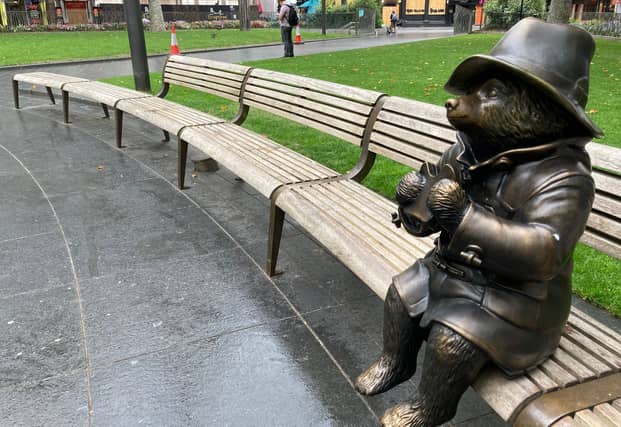

Well, who would have thought it? Paddington Bear, one of the main talking points of the Jubilee weekend. Surely not. How extraordinary then to watch this young refugee from ‘darkest Peru’ enjoy afternoon tea with Her Majesty, Queen Elizabeth the Second.
Well, who would have thought it? Paddington Bear, one of the main talking points of the Jubilee weekend. Surely not. How extraordinary then to watch this young refugee from ‘darkest Peru’ enjoy afternoon tea with Her Majesty, Queen Elizabeth the Second.
Although ‘A bear called Paddington’ first hit the bookshelves on 13 October 1958, the idea was born in the author’s mind some 15 years earlier. Michael Bond carefully observed footage of World War Two evacuees, children with brown labels around their necks and small suitcases by their sides being sent off into the unknown.
He was deeply affected by what he saw. Today, like Michael Bond, we continue to be deeply affected by the haunting television images of young, vulnerable and helpless refugees who arrive on our shores, at our stations and in our airports with few or no possessions by their sides.
‘Did you see Paddington and the Queen?’ someone asked. Very soon the conversation meandered into well-defended territory: ‘I’ve still got my teddy’ whispered one; ‘Mine’s a polar bear, he’s in the attic,’ said another; ‘Well mine is always in my bed!’ replied the whisperer, more defiantly now. ‘Unfortunately,’ came another response, ‘my partner said I had to give mine away.’
So what is it about bears or cuddly toys? Let’s return for a moment to our childhood. Learn-ed people talk about a soft, cuddly, and nice-to-touch toy or blanket being a ‘transitional object’, helping younger children make the emotional transition from dependence to independence. In the latter part of the 20th century, a classic example of a transitional object was seen in Schulz’s comic strip, Peanuts. Linus, best friend of Charlie Brown, was always drawn holding his blanket, his ‘security’ blanket as named by some.
In theory, these ‘objects’ are meant to help us sleep, to bring us comfort and to relieve some of our separation anxiety; indeed they ‘worked’ for some of us as children, not just because they felt good, but also because they were familiar.
Moving up the age range, two of our grandchildren are leaving small primary schools to attend larger secondary establishments this September. I’ve been wondering if there’s a transitional object that passes the test for an eleven-year-old as being ‘bussin’ and ‘cool’ (or is it ‘wicked’ and ‘sick’?). Anyway, something that we as grandparents can give them as a reminder of our love, something tangible that says we are with them. A marmalade sandwich perhaps?
And so finally we return to adulthood.
When someone we love dies, we may find ourselves desperate to keep any transitional object that still holds a connection with them. We fight independence, longing to feel their closeness through touching their clothing, smelling their perfume, hearing their voice on the answerphone, kissing and saying goodnight to their photo, reading and re-reading handwritten letters, having their slippers remaining where they always were; we treasure anything tangible that helps us keep their presence alive.
Others may offer us words of caution and advice: ‘Oh have you not ....Have you still got ... If I were you .... You’ll feel better if ... It’s time to move on ...’
Of course, they never can know how it is for us, they can’t really advise us and although their words are probably very kindly meant, does it matter if after ten years the slippers are still under the bed, the cap is still on the hook by the door or I’m still cuddling a rather ragged woolen jumper at night? Only we will know if and when the time is right and the right time is not about ‘moving on’. Our grief remains within us always, it’s just we grow around it, we grow around the love within us that will always remain intact.
‘Love doesn’t die, people do. So, when all that’s left of me is love, give me away.’ (Malloy)
Written by Christa Friend counsellor at North Devon Hospice