

Is impending council restructuring ‘Devon’s big gamble?
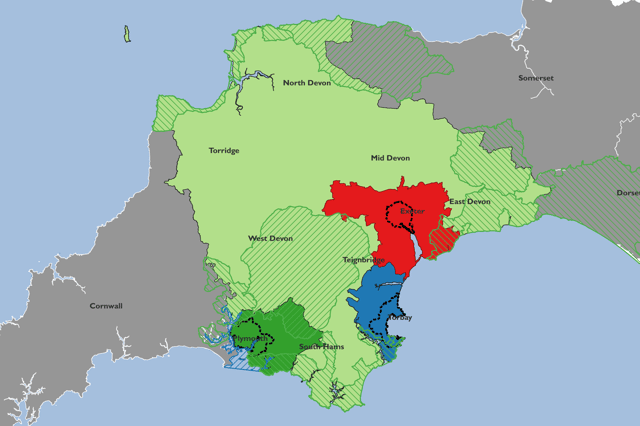

Tim Jones looks at the ‘gamble’ of plans to split Devon into four unitary authorities and asks whether it is simply ‘reorganising the deckchairs’
You will have spotted this mini tsunami in the way our local government across Devon is to be run in future.
Much media commentary has already been provided, but the reaction from businesses is only just beginning to sink in. We have seen these structural changes before, rarely have they worked out as promised and planned.
So, what are the prospects for this grand scheme?
Timing, of course, is everything, as any good conjurer will tell you. For business, consistency and certainty are critical to generate confidence and to enable forward planning.
Timing is not ideal
So, when would you choose to introduce one of the biggest changes to our local government institutions fully knowing that this will involve months of internal new plumbing and rewiring and deckchair reorganisation?
Just in the middle of one of the most volatile periods of global disruption outside a formally declared world war? At the peak of an existential threat from cybersecurity criminals?
Probably the most unpredictable and profound change to the world economic order since the invention of electricity with the advancement of Artificial Intelligence?
Just at the beginning of a UK Government reset, apparently “the most significant change in our politics for 40 years” which will involve reprogramming 149 ‘new’ ministerial posts?
Brand Burnham’s easy charm
These later towering ambitions come from our new captain (the fifth Prime Minister in four years - a role with vanishingly little job security to date).
It is with curiosity that I watch Brand Burnham’s easy charm, particularly his first target of tackling the small issue of social care reform.
I would suggest that timing is not ideal. I would also have factored in another rather important example of why this is bad timing. There is no money in the bank, not even down the back of the Treasury’s sofa.
Before getting into some initial observations about the new Devon roadmap, let me just remind you how bad are our national finances.
This is not just me unnecessarily being a purveyor of doom. These are the expert assessments from the Office for Budget Responsibility.
They calculate the UK's public debt will surge to 300 per cent of the national economy (GDP) by the mid-2070s if current policies and demographic pressures are left unchecked.
This trajectory is driven by mounting structural issues, including an ageing population, a welfare system which is dangerously out of control (the cost of just sickness and disability benefits is currently running at £59bn a year with four million of working age on Personal Independence Payments).
Radical surgery is essential immediately
Plus historic levels of appalling national productivity, just over one million NEETs (not in education, employment or training), climate (net zero) commitments, a lack of energy price stability and global security costs.
Our national debt today (96 per cent of GDP) requires us to have to repay ‘strangers’ record levels of debt interest accounting to tens of billions a year. These ‘strangers’ are no longer nice kind ladies and gentlemen sitting around their board table at one of our pension funds.
The new breed of ‘stranger’ comes straight out of the piranha tank of international hedge fund managers.
To staunch this, radical surgery is essential immediately involving making permanent and vast cuts to spending or, through fiscal tightening, raising taxes by nearly four per cent of GDP.
Whilst doing this, the involvement of us, the wealth creators, businesses great and small, on a radical programme of economic growth, is a critical component.
Perhaps, I repeat, there might have been a better moment for this - but what do we, the businesses who pay the taxes, know?
Just to remind you...
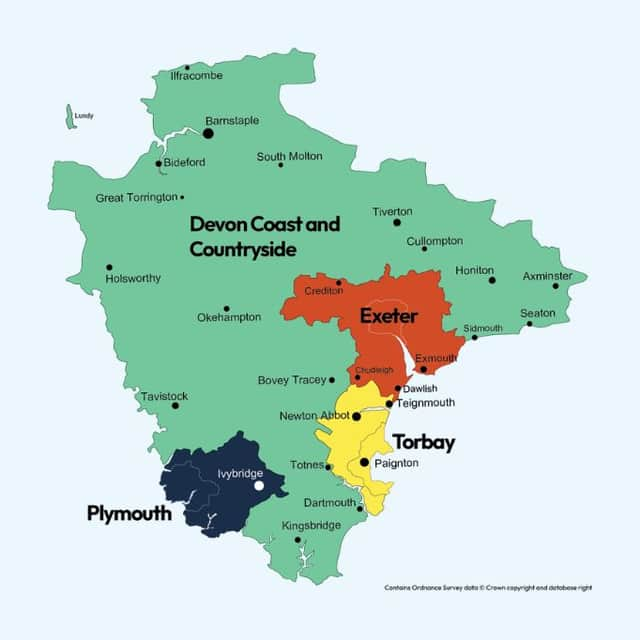
So just in case you need reminding, Government has announced we will have four new unitary authorities across Devon.
The old two-tier system (county and district councils) disappears for a brave new world to emerge (possibly).
The model chosen for us by Whitehall is one of five (or was it six) options put forward. The successful candidate was the plan proposed by Plymouth and Exeter.
This whole exercise is intended to create councils that are responsible for the full range of local government services within their areas, replacing existing arrangements where responsibilities are shared between county council.
Key milestones in the programme are expected to include the development of detailed transition arrangements, the introduction of the necessary legislative changes, elections to new authorities in 2027 and implementation of the new arrangements ahead of vesting day in 2028.
Government are committed to devolving power of out of Whitehall
There are no immediate changes to the delivery of council services. Services will continue to operate as normal while further work is undertaken to plan and implement the new structures.
Similar messaging has previously been provided to staff through local government reorganisation updates, which states that no immediate changes to services, roles or structures would take place while decisions and future arrangements were being considered.
We should also remind ourselves that this is only part of a two-stage process of devolution. Government are committed to devolving power of out of Whitehall so that they can “rebalance wealth, power, and opportunity across our country.”
They remind us that we are the second richest country in Europe, and yet England has seven of the 10 poorest regions in Northern Europe. This supports the case for further change.
So, keep your seat belt on and look forward to what Mayors have to offer. There is additional ‘good news’, government are generously throwing £1m into the pot of each new unitary authority to help them with the transition.
I am probably a bit of a Luddite in saying I like the old system, much that it needed better cost efficiency and a joined-up approach to children and adult social care management.
So, back to the key questions, what does this all mean and will it work?
As we sadly know, every generation of politicians seems convinced it has finally discovered the perfect structure for local government.
Businesses have seen this film before and very rarely do the closing clips reflect the expected outcomes. Seldom does the princess find her prince.
This one is no different from previous attempts but, as proved before, is a huge gamble. On paper, it sounds entirely reasonable. The ambition of less bureaucracy, clearer accountability, lower costs and stronger economic leadership is logical and laudable.
We’ve all seen this film before...
From the perspective of those of us who are trying to run a business in Devon, however, it sounds rather more familiar than reassuring, because business has learnt a hard lesson over decades of public-sector reform.
Structural change consumes enormous amounts of management time, money and energy long before it delivers any measurable benefit. Sometimes those benefits never arrive at all.
Government invariably presents reorganisation as if changing operational charts automatically improve performance. They don’t. They merely change who occupies which boxes on the chart.
These are the issues holding Devon back
Meanwhile, the real economy must carry on. In my judgment Devon can do without this distraction particularly as we are, in addition to international dislocations, already wrestling with rising employment costs, higher National Insurance contributions, skyrocketing energy bills, inflationary pressures, fragile consumer confidence and stubbornly weak productivity.
Planning delays continue to frustrate investment. Skills shortages remain acute. Transport infrastructure still lags behind much of the country. Housing shortages affect recruitment.
These are just some of the issues holding Devon back. Few of us business leaders wake up in the morning thinking the real obstacle to growth is the number of council logos on official letterheads.
Yet for the next three or four years, senior officers, councillors and public-sector managers will be diverted from essential frontline duties and must inevitably devote thousands of hours to restructuring organisations instead of improving services. That opportunity cost rarely appears in ministerial press releases.
Our local authorities are also some of our biggest wealth contributors and employers. These are the hidden bills nobody likes discussing.
Nothing about this comes cheaply
Government tries to pull the wool over our eyes talking about long-term savings. It is, however, noticeably quieter about upfront costs.
Every council merger requires new IT systems, legal restructuring, property transfers, harmonising employment contracts, pension arrangements, branding, procurement systems, governance frameworks, electoral changes and management restructuring.
Nothing about this comes cheaply. Experience elsewhere suggests implementation costs frequently run into tens of millions of pounds before any savings begin to emerge.
Some reorganisations have eventually produced efficiencies. Others have taken far longer than expected to break even because the complexity of merging large public organisations was underestimated from the outset.
In light of this, the derisory offer the government has made of transitional funding to support the process will cover only a fraction of the overall exercise. The rest ultimately comes from us, the wealth creators.
Taking us for mugs is insulting. Businesses know exactly how this works. When companies merge, shareholders expect years of integration work before synergies appear.
Taking us for mugs is insulting
Government somehow manages to describe exactly the same process as an immediate efficiency saving. Nobody in the private sector would produce a merger business case that ignored implementation risk. Yet Whitehall too frequently appears blindly and irresponsibly optimistic.
There is an almost theological belief within central government that bigger is better and smarter; ergo larger councils will inevitably perform better. The evidence simply isn’t that straightforward.
Cornwall is often presented as the success story. Its unitary authority undoubtedly simplified governance and gave the county a stronger strategic voice.
But Cornwall also benefits from a unique geographic identity that Devon simply does not possess.
Devon is different. Plymouth has different priorities from rural Torridge. Exeter has different housing pressures from South Hams. Northern Devon faces economic challenges entirely unlike those in East Devon.
Creating four large authorities does not remove these differences. It simply relocates the arguments into bigger organisations. Indeed, one might argue that some local voices become harder to hear.
Markets dislike uncertainty
The promise of streamlined decision-making can quickly become the reality of more distant decision-making. There must, I mischievously suggest, be a strong case for councillors representing the Rural and Coastal Unity to have extra fuel allowances and a crash course in the use of Sat Nav.
The word ‘uncertainty’ can never be replaced by ‘curiosity’. Markets dislike uncertainty. Investors dislike uncertainty. Employers dislike uncertainty.
Council reorganisation creates uncertainty in industrial quantities. Planning departments are reorganised. Economic development teams are restructured. Procurement rules change. Senior officers leave. Political leadership changes. Departments merge. Responsibilities shift.
Businesses trying to invest suddenly find themselves wondering who is actually making decisions. That uncertainty has a cost. It may never appear in government accounting. It is very real, nonetheless.
One of the constraints to good business is an obsession with structures. Businesses thrive on a cocktail of adrenaline and animal spirits. Britain has developed an extraordinary habit whenever public services struggle.
Rather than asking whether leadership, culture or funding are the problem, we redraw organisational maps. Health service reforms. Police reorganisations. Combined authorities. Integrated care system. County councils. District councils. Now unitary councils.
The map changes with remarkable regularity. Yet the underlying economic challenges remain remarkably consistent.
Lessons should be learnt from elsewhere
No business would continually reorganise itself every decade while expecting employees to maintain perfect productivity throughout. Yet government seems permanently fascinated by institutional redesign.
Maybe it is unreasonable to suggest that lessons should be learnt from elsewhere. Supporters point to Cornwall and Wiltshire. Critics point elsewhere.
Northamptonshire’s previous local government arrangements collapsed financially before being replaced by new unitary councils. The structural change improved governance but did not magically remove financial pressures.
Bournemouth, Christchurch and Poole spent years managing political tensions and integrating very different organisations following reorganisation.
Elsewhere, promised savings have often taken considerably longer to materialise than initially forecast. This is not because local government lacks capable people. It is because organisational mergers are inherently difficult. Private companies understand this. Government often behaves as though local authorities are uniquely immune. They are not.
Democracy is not measured solely by administrative efficiency
Efficiency matters. But so does representation. Democracy has a value. Larger authorities inevitably mean larger electoral divisions. Councillors represent more residents. Decision-makers become more distant. Local identity weakens.
That may be a price worth paying if services improve significantly. But ministers should at least acknowledge there is a trade-off. Democracy is not measured solely by administrative efficiency.
So, there are some real questions here. The government argues that four unitary councils will provide stronger strategic leadership. Perhaps. But leadership does not emerge because organisational charts are redrawn. It emerges because capable people make good decisions.
Equally, weak leadership survives almost any governance model. Changing the institution does not automatically change the behaviour. Businesses understand this instinctively.
Culture always defeats structure. So, much as businesses normally step up to the plate, don’t expect us to be part of the solution here. This is not our poop-bag.
So, what does Devon actually need?
If ministers genuinely want to unlock Devon’s economy, businesses could produce a remarkably consistent wish list. Faster planning decisions. Reliable transport infrastructure. Improved digital connectivity. Better vocational skills. More affordable housing. Greater certainty for investors.
Those are the reforms capable of transforming economic performance. Whether those services are delivered by eight councils or four is arguably of secondary importance. Businesses judge outcomes. Government too often celebrates process.
So, for me this is a gamble rather than a certainty. None of this means the reforms are guaranteed to fail. Yes, I can of course see that building critical mass is vital for Plymouth and Exeter. Agglomeration is a real thing, but these centres are not and should never be fortresses.
For centuries Exeter has been the ‘market town’ for Devon, the mother ship. Plymouth does and should continue to be aspiring to become a global city, for that it deserves our support, and whatever geographical flexibility it needs. The whole county can benefit from this economic hot spot.
I suppose that this experiment could ultimately succeed. Good leadership could create more coherent strategic planning. Duplicated administration may well reduce over time. Long-term efficiencies are entirely possible.
But ministers should stop presenting those outcomes as inevitable. They are aspirations, not guarantees. Every major organisational merger carries substantial execution risk. Every integration creates disruption. Every restructuring absorbs management attention. Every promise of future savings depends upon flawless implementation.
Anyone who has ever managed a merger knows that. Brexit may have had its pros and cons but in reality, it has lost us £79bn of trade and weakened our GDP by five to six per cent.
So, my verdict?
Steve Reed is asking Devon to embark upon one of the largest institutional reorganisations in decades. He may ultimately be proved right.
Equally, Devon could spend years consumed by organisational change while the problems businesses actually care about continue largely untouched.
The greatest risk is not that the reforms fail completely. This might succeed administratively while failing economically.
Businesses are generally remarkably pragmatic. They care little whether the council collecting bins has one logo or four.
They do care whether planning applications are processed on time. They do care how national and international markets judge us. They do care whether roads are repaired. They do care whether staff can find housing. Whether investors receive decisions quickly. Whether public services support economic growth rather than delay it.
If, five years from now, those outcomes have materially improved, history will judge the reorganisation kindly.
If not, Devon will simply have acquired four new councils, several million pounds of transition costs, squandered the talents of many senior officials by embroiling them in years of organisational disruption and successfully written yet another chapter in Britain’s long tradition of believing that changing structures is easier than solving problems.
Business has seen this film before. We have every right to question whether this remake will end any differently.