

Councillor to meet South West Water bosses after children fall ill following river swim


Cllr Ed Tyldesley is set to meet South West Water officials after five children became unwell following an afternoon in the River Little Dart.
A leading county councillor is set to meet water company officials following an incident in which children playing in the River Little Dart became ill.
Councillor Ed Tyldesley, the Devon county councillor for the Chulmleigh and Landkey division, is concerned that a sewage discharge upstream of a popular paddling spot in Chawleigh may be linked to the illness suffered by five children from two families, after they spent an afternoon in the river.
Later that evening, the children began vomiting and suffering from upset stomachs, with several becoming quite unwell overnight, according to councillor Tyldesley. Around 20 other people were reportedly in the river at the same time.
Councillor Tyldesley wrote to South West Water the day after the children entered the water on June 25, after a Chulmleigh resident contacted him following the incident. In his letter, he said the resident had checked the sewage discharge map after the children fell ill and discovered that South West Water had discharged untreated sewage into the river upstream of where the youngsters had been playing, with the discharge reportedly lasting approximately 16 hours.
“I am absolutely furious that families in Devon are apparently expected to consult an online sewage map before allowing their children to paddle in a local river,” he wrote. “The resident has told me that she feels guilty for not checking the map beforehand. She should not feel guilty. The responsibility lies with the company discharging sewage into the water, not with parents who reasonably believed that a popular local paddling spot was safe.”
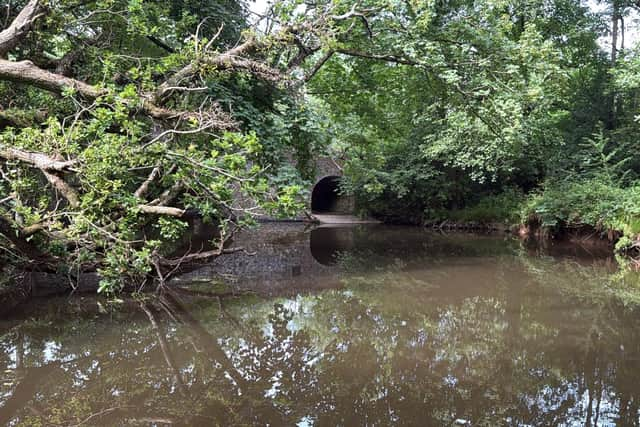
Councillor Tyldesley acknowledged in his letter that the cause of the children’s illness had “not yet been formally established,” but said the circumstances were “deeply alarming” and demanded an immediate investigation. He asked South West Water to explain what caused the discharge, confirm whether it would contact the affected families, detail what warnings had been given to river users and set out what action would be taken to prevent a similar incident.
He also criticised the company more broadly, saying it was “unacceptable” that South West Water continued to discharge sewage into Devon’s rivers “while customers face rising bills and Pennon Group’s senior executives receive substantial financial rewards”.
The local government affairs team at South West Water, responded to councillor Tyldesley, in correspondence he has shown the Gazette, confirming the company was carrying out an internal investigation and that it had also shared his letter with the local MP.
The affairs team confirmed there are two storm overflows upstream of the swim location at Chawleigh: the Witheridge sewage treatment works (STW) storm tank overflow, around 11km upstream, and the Rackenford STW storm tank overflow, around 18km upstream, both measured along the route of the river.
South West Water’s review found that a discharge from Rackenford STW occurred on June 22, lasting half an hour. At Witheridge, monitoring data had initially indicated a discharge lasting approximately 16 hours, but the company said its review had since validated the duration at 47 minutes and 24 seconds.
The affairs team explained that the near real-time data shown on public platforms such as WaterFit Live is based on readings from ‘event duration monitors’, which is displayed before validation is complete. The affairs team said factors other than an actual discharge can occasionally trigger a reading, and that WaterFit Live “does not currently distinguish between verified and unverified activations”.
On the illnesses, the affairs team said South West Water had been notified by the Environment Agency on June 25 following a member of the public’s report of dark, murky water. An operational team attended the site and carried out an ammonia test, which did not indicate pollution, and as a result no samples were taken for laboratory analysis. The affairs team noted that around 11 kilometres of river lie between the Witheridge discharge point and the swim location, with several tributaries feeding into the catchment, and pointed to factors such as dilution, travel distance and sunlight exposure as relevant considerations. The affairs team added that river water quality can be affected by multiple sources, including agricultural and urban pollution, and referred to Environment Agency catchment data on the wider Little Dart catchment.
The affairs team offered to meet councillor Tyldesley in person, either at Witheridge or Rackenford STW, or at a location of his choosing.
Responding on July 6, councillor Tyldesley accepted the offer of a meeting, proposing a site visit that would include Witheridge STW and the swim location at Two Bridges on the Little Dart in Chawleigh. He said he would welcome the involvement of the Environment Agency, and indicated that he had copied in councillor Paul Arnott, Devon County Council’s cabinet member for water quality, in the hope that he would also attend.
However, councillor Tyldesley said he remained “deeply concerned” by what he described as an apparent attempt to distance South West Water from potential responsibility before the investigation had concluded. He noted that discharges had been confirmed at both Rackenford and Witheridge during the relevant period, adding: “a shorter discharge is not the same as no discharge,” and that it remained reasonable to investigate whether either discharge had contributed to the state of the river.
He also raised concerns about the reliability of the public-facing monitoring data, asking when the reported 16-hour Witheridge activation was corrected, what triggered the correction and what steps South West Water would take to ensure the public was not relying on inaccurate information.
On the testing carried out at the scene, councillor Tyldesley said the absence of an ammonia reading did not demonstrate the water was free of human faecal bacteria and that the decision not to take samples for laboratory analysis had lost an opportunity to test for contamination linked to gastrointestinal illness. He said he had “very little faith” in South West Water’s ability to recognise a cryptosporidium outbreak before it escalated, referencing the company’s prior handling of a cryptosporidium case in Brixham.
He said the incident had since been reported in the North Devon Gazette and the Daily Express, with further accounts of children suffering severe vomiting and stomach illness after entering the river, though he acknowledged that press coverage did not by itself establish the source of the contamination.
Councillor Tyldesley said that while factors such as distance, tributary flows, sunlight and dilution were relevant, they were “not sufficient grounds to rule out the possible effects of confirmed upstream discharges”, particularly given low summer river flows. He said it would be “premature and inappropriate” to suggest the illnesses were unrelated to South West Water’s assets before the Environment Agency and other authorities had completed their investigation.
At the proposed meeting, he said he intended to examine the full validated ‘event duration monitor’ and telemetry records, the estimated volume and nature of each discharge, rainfall and river-flow data, the decision not to carry out laboratory testing and the timetable for ongoing environmental surveys and modelling. Councillor Tyldesley said he had previously worked as a water-quality chemist and was willing to review the technical data himself.
“The families affected deserve a thorough and open investigation which follows the evidence wherever it leads,” he said. “I hope South West Water will approach our meeting on that basis, including a willingness to examine fully the possibility that its own discharges played a part.”
South West Water responds
South West Water has since provided a further response to the Gazette.
On the status of its investigation, and whether it will attend the proposed joint site visit at Two Bridges and Witheridge STW with Cllr Tyldesley and the Environment Agency, a spokesperson said: "We have completed a review and are sharing the validated findings with the Environment Agency. We welcome the opportunity to meet with Councillor Tyldesley to discuss the matter further, and are in the process of discussing this with him."
On the accuracy of the public-facing WaterFit Live data, following the revision of the Witheridge discharge duration, the spokesperson said: "Waterfit Live (WFL) operates in near real time, and therefore all data which appears on the WFL website is unverified. The sensitivity of the monitors used means that sometimes alternative sources can trigger false readings, indicating that the overflow is active when it is not. The map does not distinguish these 'false' readings, but provides near real-time data, as SWW receives it, before it is investigated further as to why a monitor is activated."
It is understood that WaterFit Live relies solely on live, unverified data from Event Duration Monitors to provide an early warning on South West Water's website, published in near real-time, under an hour, in line with regulatory requirements intended to let the public consider potential risks to water quality. This means the data cannot be practically verified before publication; verification is instead carried out afterwards by reviewing other operational and meteorological data from the site to establish whether a spill actually occurred.
It is understood that South West Water carried out on-site water quality testing on the evening of June 25, after being advised by the Environment Agency that afternoon of reported illness among children using the river at Leigh Bridge. The samples taken are understood to have been analysed and to have come back clear. South West Water is understood to be continuing to support the Environment Agency's investigation into water quality in the Little Dart River.