

‘You stupid boy’: Tales of the RAF, Spitfires, and a lost MG in the hangar

Broadcaster David ‘Fitz’ FitzGerald shares his personal memories of Exeter Airport, from the engineering genius of the Spitfire to the time he was coated in the Red Arrows’ iconic smoke
I was exceedingly lucky a few weeks ago when I was allowed onto the apron at Exeter Airport to witness the landing of the Spitfire K5054, a Supermarine Type 300, to mark the 90th anniversary of the first flight of this iconic aircraft.
As the organisers said, this was a once-in-a-lifetime journey travelling around the country displaying this grand old lady to a nation who owes so much to the aircraft and the pilots who flew it.
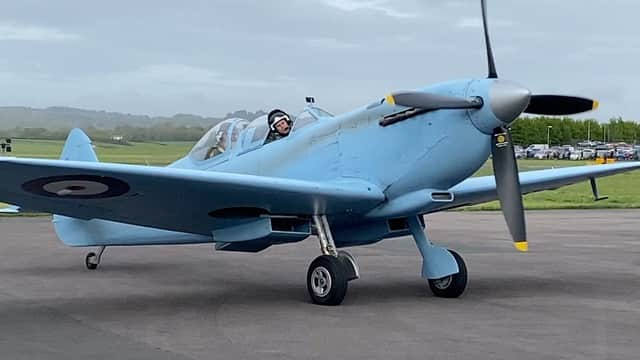
ABOVE: Pilot Matt Jones in the cockpit of Spitfire K5054. David Fitzgerald captures a moment on the ground at Exeter Airport, marking the 90th anniversary of the aircraft's first flight. Matt, a local South Devon man, later flew over his own house during the historic journey.
Standing on the apron, the aircraft was surrounded by the press and, ironically, swallows darting underneath the wing and across the grass trying to feed on the thousands of flies that had been disturbed by the backdraft of the Spitfire’s arrival.
It was R.J. Mitchell in the 1930s who allegedly was watching swifts and swallows flitting through the air and took inspiration from their shape in flight to design that now famous elliptical wing.
This was not the first time that I had gone ‘airside’ at Exeter Airport; in fact, I was a regular visitor to the Exeter airshow not only as a guest of the event but also as a reporter.
I remember on one particular occasion I joined the team of The Red Devils, the parachute display team, and was interviewing one of the members inside a Hercules aircraft as it climbed higher and higher over the airfield.
As the interview came to a natural break, he thanked me but said he had to go now as the door behind him began to slide open.
It was a strange experience to see him smile, wave and step out of the aircraft.
It was then that I noticed that the back ramp of the Hercules was wide open and the rest of his friends were tumbling out into the ether.
Half an hour later we were all on the ground having a drink; I got there via the slightly slower but normal way.
As the old saying goes, everyone on an aircraft should have exactly the same number of take-offs to landings—no one needs to get out halfway.
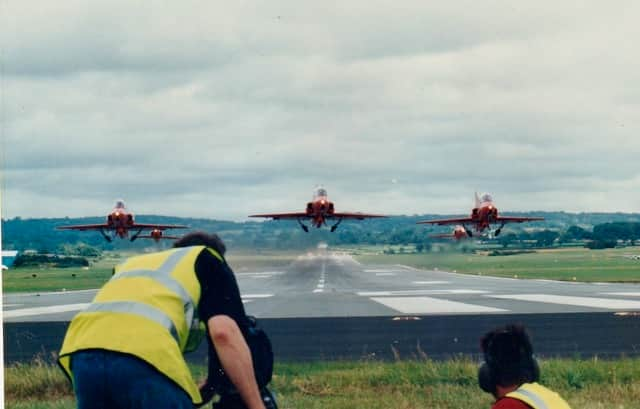
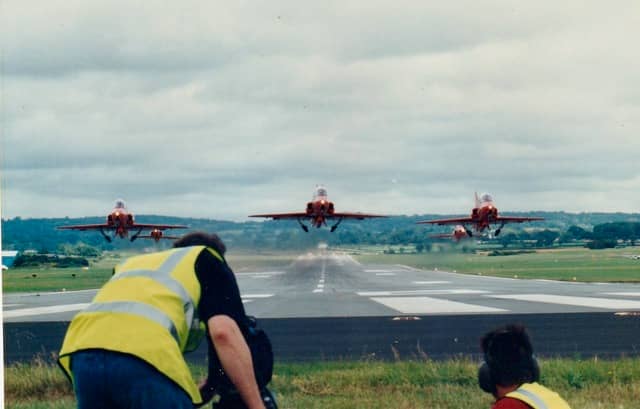
ABOVE: The Red Arrows prepare for take-off at Exeter Airport. David Fitzgerald recalls the exhilarating (and slightly messy) experience of filming at the end of the runway as the team came in with 'smoke on,' leaving the crew with a coating of red, white, and blue.
I would have taken a photo at the other end of the runway as they landed but they decided to come in with ‘smoke on’.
The famous red, white and blue smoke trails they leave in the skies are created by spraying diesel into the hot exhaust.
At height it is vapourised… if you land with ‘smoke on’ anything underneath has a curious smell of DERV!
I was used as a training bombing target and got a thin coating of red, white and blue… still, I have been rust-free for years.
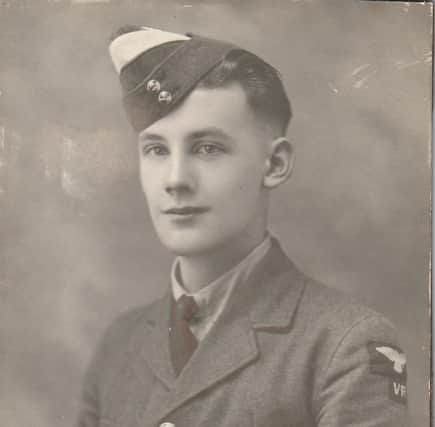
ABOVE: David’s father, Desmond Fitzgerald, an RAF engineer who maintained the Merlin engines of Spitfires and Hurricanes during the war. he lived a long, happy life in Torquay, never losing the sense of humour shared with his son
But his tales of the Spitfire used to intrigue me.
Firstly, whenever they were stripping out the engine—the Merlin—if they were not needed, the spare cylinder heads were turned into ashtrays!
Needless to say, when I asked him if we had any in the family, the answer was no… he’d thrown them all away.
Please check any auction website for the value of such an item!
But by far his most intriguing story was when he was based at an airfield just south of Manchester.
One day, he noticed at the back of the hangar a small, very battered two-seater MG sports car in dark green.
It was still there some five days later and when he started to inquire, several people remembered a pilot had arrived to pick up an aircraft and deliver it to the south coast.
Another week went by and the sad realisation that the pilot was not coming back spread around the ground crew.
This was not an uncommon situation.
Some three weeks later the phone rang and a voice said, ‘Have you got a battered, two-seat dark green MG in the hangar?’
My father confirmed that it was still here and, suspecting he was talking to the next of kin, added, ‘I am so sorry for your loss.’
‘Well, it’s not actually lost, I just couldn’t remember which airfield I had left it at.’
It was the pilot!
‘I have done a dozen sorties since I landed with you and your blackout meant I couldn’t read the name of the air station… I’ll pop by at the end of the week.’
Another car-related story involving my father came when he was helping to prepare a Halifax for a bombing run.
All was set and off flew the ‘big beast’ banking over the airfield and turning west… WEST?
The aircraft was tracked for about ten minutes and finally radio silence had to be broken.
Somewhere on a heading for Wales, the pilot finally answered his call.
It was pointed out to him that Germany was the other way!
‘My compass is out… oh hang on!’
After he removed his car keys which had been draped around the compass body, he adjusted his course.
The aircraft returned safely and a suitable lecture on the effects of metal on compass function was delivered… at full volume by a Group Captain.
Towards the end of the war, my father and his comrades slept under the wings of the aircraft to make sure they could get into the air quickly in a scramble.
Sadly, because of the conditions, he managed to contract pleurisy and one of his lungs started to fail.
He was rushed to a military hospital and was given the last rites in 1943.
He died in 2009 in Torquay after a long and happy life and even to the very end we shared a sense of humour.
As he was lying in the ward with a doctor trying to analyse his situation, I was asked if he had had any major medical issues in his life.
I mentioned the pleurisy… the freezing cold airfields and that one of his lungs had collapsed.
Searching his chest with a stethoscope the doctor asked, ‘Which side did it affect?’
I said, ‘I don’t think the Germans were too worried, but the RAF sent him home for the weekend.’
I got a final intolerant look and the immortal line: ‘You stupid boy.’