

Research uncovers identity and naval career of boy depicted in early Joshua Reynolds masterpiece
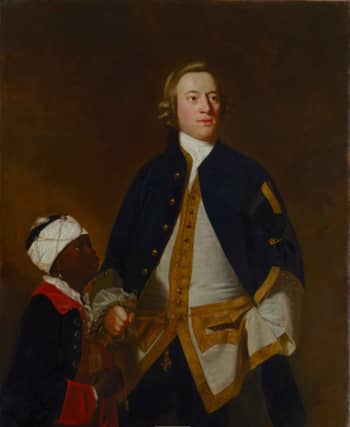

New research has uncovered the real-life story behind the enigmatic figure known as “Jersey” in one of Sir Joshua Reynolds’ earliest masterpieces, revealing details of the young Black boy’s naval service and identity for the first time.
The findings will form part of a major new display, Jersey’s Story, at Saltram from 23 May to 1 November 2026, where the newly conserved portrait will go on public display alongside its companion painting for the first time in more than 200 years.
The painting, Lieutenant, later Captain, Paul Henry Ourry, MP (1719-1783) with an enslaved child known as “Jersey”, was completed around 1748 and has long been part of the collection at the National Trust’s Saltram estate near Plymouth. Although recognised as Reynolds’ earliest known depiction of a person of colour, little had previously been known about either the naval officer Paul Henry Ourry or the boy shown beside him.
Now, a collaboration between National Trust, National Gallery and Royal Museums Greenwich has uncovered archival evidence identifying the child as “Boston Jersey”, later baptised as George Walker.
Researchers examined Admiralty documents, muster books, captains’ logs and original letters, discovering that Boston Jersey served aboard three Royal Navy ships - HMS Salisbury, HMS Monmouth and HMS Deptford - between 1747 and 1753.
Mark Brayshay, volunteer researcher at Saltram and Emeritus Professor at the University of Plymouth, said the project aimed to restore Jersey’s identity and humanity.
“A key motivation for our research was to explore whether more could be discovered about Jersey than merely his supposed name. Could we acknowledge and honour him as a distinct individual, and affirm his life as a person with hopes, potential and aspirations?”
The portrait depicts Ourry as an ambitious young naval lieutenant, while the boy beside him wears a navy-blue coat, scarlet waistcoat, white turban and pearl earring.
Prof Brayshay explained that Georgian-era portraits of wealthy white sitters often included figures of different ethnicities, sometimes imagined, to demonstrate the importance and social standing of the main subject.
However, the new research has revealed that Jersey was a real individual whose life can now partly be traced through naval records.
“We've been able to confirm that he was indeed known as Jersey, but as a surname, rather than a first name. In Admiralty records from the Royal Navy ships on which he served as Ourry’s ‘servant’ from 1747 to 1753 (HMS Salisbury, Monmouth and Deptford), he is recorded in musters as Boston Jersey.”
Researchers believe “Jersey” may have referred to Ourry’s family origins in Jersey. Ourry’s Huguenot family had fled religious persecution in France before settling there. The origin of the name “Boston” is less certain, although historians suggest the boy may once have lived in Boston before arriving in England.
The team also discovered a Westminster baptism record from July 1752 for “A Certain Black Boy Called Boston Jersey Baptised by the name of George Walker aged fifteen”, placing him at around 11 years old when Reynolds painted the portrait.
Another significant finding showed Jersey was promoted while serving aboard HMS Monmouth.
“A muster taken in 1751 records that Boston Jersey had been repositioned in the crew list from second place, as the servant of Ourry, to a place among the rest of the crew. Later, his name appears as one of 10 crew members due for discharge ‘per paybook’. This could imply that Jersey was in receipt of Royal Navy pay, but it is also possible that the sums owing actually went to Ourry.”
After being discharged from HMS Deptford in 1753, probably at Port Mahon, no further records of Boston Jersey or George Walker have yet been found.
Historian and broadcaster David Olusoga said the work had helped bring Jersey’s story back into public view.
“This project asks us to look more closely at a familiar past, revealing a life long obscured and reminding us that history is shaped as much by those rendered invisible as by those remembered. To tell Jersey’s story is to confront the silences within our history, and to recognise the individuals whose lives have too often been hidden from view.”
Alongside the archival discoveries, technical investigations of the painting, including infrared reflectography, X-radiography and paint analysis, revealed more about Reynolds’ artistic process. Experts found evidence that Jersey may not have been painted during the original sittings, suggesting he was initially treated as a secondary figure within the composition.
Conservation work carried out at the National Trust’s Royal Oak Foundation Conservation Studio in Kent has now restored previously obscured details. Painting Conservator Sarah Maisey was able to bring clarity back to both Ourry and Jersey, by removing old layers of varnish and non-original paint, followed by reversible inpainting.
Saltram's Property Curator, Zoe Shearman, said: “Sarah’s work has brought both sitters more completely into view so we can appreciate details that weren't visible before. In particular, Jersey’s sensitively painted facial features are revealed more sharply, as are the beautiful details on his clothing, down to the filigree pattern on his headdress. Mark Brayshay describes it as a dazzlingly good and unforgettable portrait, and I think visitors will agree.
“Through this project, we’ve been able to see Jersey more clearly – through what we now know of his life and naval career, but also through how he was portrayed on the canvas. In time we may discover more, but Boston Jersey is at last given recognition as a person and shown as more than just a trope.”
The exhibition will also reunite the portrait with Reynolds’ companion work, Captain the Honourable George Edgcumbe, 1720-95, on loan from the National Maritime Museum. The two paintings were originally commissioned by the Corporation of Plympton and are believed to have been painted in Reynolds’ studio in Plymouth Dock, now Devonport.
Both paintings will be on display at Saltram House from 23 May to 1 November 2026.