

From Tennyson to McGonagall: The poets who found inspiration on the English Riviera

How Victorian Torquay became a literary hotspot for celebrated writers, eccentric performers and some of Britain’s most memorable poetry
During the nineteenth century, poetry was hugely popular.
Due to advances in literacy and publishing, poems were being read by a wider audience, from schoolchildren to Queen Victoria herself. Books by the most popular poets routinely sold out through several editions.
As the richest town in the nation Torquay consequently attracted poets, first as sightseers and then as performers and residents. Among all the Victorian female poets, for example, none was held in higher critical esteem than Elizabeth Barrett Browning who lived on the harbourside. During the years of her marriage to Robert Browning, her literary reputation far surpassed that of her poet-husband.
Not all Victorian poetry featured themes of love and beauty, however. Many poems were political and carried the ideas and assumptions of the era. For instance, in 1899 Rudyard Kipling, one time resident of Maidencombe, promoted racist imperialism in The White Man's Burden, a poem that encouraged the United States to assume colonial control of the Filipino people and their country.
In 1838 Alfred Tennyson, 1st Baron Tennyson (1809-1892) was in town, a place he called “the loveliest sea village in England” though he “had no money for touring, nor did he wish for change”.
In 1830 Tennyson had published his first solo collection, Poems, Chiefly Lyrical. This proved popular and brought the poet to the attention of well-known writers of the day, such as Samuel Taylor Coleridge. His medievalism and powerful visual imagery became a major influence on the Pre-Raphaelite Brotherhood which, in turn, influenced the art and culture of our Bay.
In 1842 Tennyson published Poems, a two-volume collection which established his reputation as one of the greatest poets of his time. This featured both new and reworked poems, including The Lady of Shalott, The Lotos Eaters, Ulysses, and Break, Break, Break. Throughout Poems we see Tennyson bringing together drama, fiction, and lyric into a dramatic monologue form.
The collection also included Audley Court. Tennyson later told his son that this poem was inspired by Abbey Park where it was written on that Torquay visit in 1838. The final lines describe the scene from Waldon Hill:
“The limit of the hills; and as we sank, From rock to rock upon the gloomy quay, The town was hush’d beneath us: lower down, The bay was oily-calm: the harbour buoy, With one green sparkle ever and anon’ Dipt by itself, and we were glad at heart.”
Audley Court reflects Tennyson’s observations of rural life and social issues during a conversation held during a picnic at the Abbey’s grounds. The topics include hunting, farming, the corn laws, and marriage, all set against a background of social change. The poem is an example of how Tennyson dealt with the doubts of an age in which established Christianity and traditional assumptions about human nature were increasingly being called into question by science and modern progress.
We still remember him from phrases he used such as ‘Nature, red in tooth and claw’, ‘'Tis better to have loved and lost / Than never to have loved at all’, and ‘Theirs not to reason why, / Theirs but to do and die’.
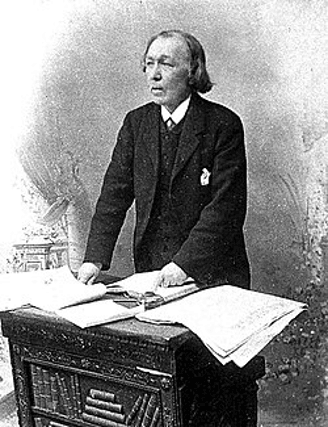
From 1850 Tennyson served as Poet Laureate during much of Queen Victoria's reign, though not all Victorian poets were from the middle classes or aristocracy. A notable exception was the working-class Scottish poet William McGonagall (1825-1902) who came from a far different tradition of public performance.
William was the antithesis of Tennyson. He did acquire fame of a kind, but not for respected and admired compositions of great poetry.
Indeed, William is now regarded as the author of some of some of the worst poems in the English language. Admittedly, to both the Victorian and modern ear these are exceptionally bad, but they remain somehow wonderfully entertaining. One reason for William’s reputation is that his primary understanding of poetry was that his lines needed to always rhyme, regardless of any other consideration.
It was in 1877 that the Dundee factory loom worker decided to become a poet. He wrote to Queen Victoria seeking her patronage and subsequently received a letter written by a royal functionary thanking him for his interest but rejecting his request. William nevertheless took this as recognition of his "poetic abilities" and in July 1878 walked 60 miles from Dundee to Balmoral to perform for the Queen. When he arrived, he announced himself as "The Queen's Poet". The guards replied “You're not the Queen's poet! Tennyson is the Queen's poet!" and he was sent away.
Undeterred, William continued his mission, declaring that he was "more versatile than Shakespeare". He certainly became a prolific writer and performer with a repertoire of around 200 poems, the most famous of which is The Tay Bridge Disaster. All though his life he remained convinced of his own genius, caring little for his peers' or the public’s opinions of his work.
William’s poetry readings were the opposite of the theatre and refined drawing room performances of Tennyson and his fellow respectable poets. The Dundee poet’s recitations were in music halls, the circus, and in pubs where he was frequently interrupted and drowned out, pelted with eggs, flour, herrings, potatoes, and stale bread. On occasion he was even forcibly carried out of a venue and paraded in the streets.
Throughout his life, William opposed excessive drinking. There was, of course, a very active Victorian abstinence movement though few Teetotal campaigners actually recited poems about the evils of "strong drink" in pubs as did William to the dismay of publicans.
William is included here as he wrote one of his poems about Torquay. This was Beautiful Torquay and, though we unfortunately don’t have the space to print the full poem, here are a few excerpts. Beautiful Torquay begins:
“All ye lovers of the picturesque, away, To beautiful Torquay and spend a holiday, 'Tis health for invalids for to go there, To view the beautiful scenery and inhale the fragrant air, Especially in the winter and spring-time of the year, When the weather is not too hot, but is balmy and clear.”
Babbacombe only became a part of Torquay after William’s time, but he did visit and we have his praise for the ancient village:
“The lodging-houses at Bablicome are magnificent to be seen, And the accommodation there would suit either king or queen, And there's some exquisite cottages embowered in the woodland, And sloping down to the sea shore, is really very grand.”
William died penniless in 1902 and is buried in an unmarked grave in Greyfriars Kirkyard in Edinburgh. But maybe he was just born before his time. He was a skilled working-class comic character and today he would probably have his own comedy series on Channel 4.
It’s said that in our twenty-first century, poetry is loved by a few, loathed by many, and bought by almost no one. Yet, poetry remains the language of how we see the world and of our deepest experiences. We still turn to poetry when want the genuine and heartfelt. There’s always an appropriate few lines somewhere, especially when we want to convey our feelings at weddings, funerals, and proposals. As that other Torquay visitor the poet TS Eliot once said, “Genuine poetry can communicate before it is understood”.
So, whether it is good, bad, or indifferent, we still fall back on that most ancient of art forms when everyday conversation just isn’t enough.
So, let us leave the last words to that eccentric Dundee poet as he offers words of praise to our town:
“And, in conclusion, to tourists I will say, Off! off to Torquay and make no delay, For the scenery is magnificent, and salubrious the air, And 'tis good for the health to reside there.”