

Exploring Devon’s past through folklore, history and ghostly tales

A rediscovered book, Devon Yarns, brings local legends and real-life mysteries back to life from haunted castles to Dartmoor traditions
As part of my ongoing research, looking for further inspiration for my articles to share with you, I often find myself in second hand bookshops, seeking out something old, but new to me. A couple of years ago, in an excellent shop in Newton Abbot, I made several useful purchases, one of which I’ve finally gotten around to reading. It’s called “Devon Yarns”, and is by Christina Green, a writer of local history books, as well as historical romances and novels.
First published in 1995, I was aware of its release, but, at that time, the market was flooded with handy, pocket-sized books, covering lots of local folklore and spooky stuff, that I initially overlooked it. At first glance, it didn’t seem to be a typical addition to the genre, but, reading it in depth now, it is actually more than that, and I’m glad I’ve finally added it to my collection, for the tales it tells, aren’t just about fantastical folklore from long ago, but how more recent historical events have been drawn into the realms of the storyteller. I will give you a taster of what the book has to offer, and, where appropriate, add in some of my own knowledge of the subject matter of some of the chapters, of which there are 23 in total.
Of course it does feature its fair share of well-known local stories, kicking off with the tragic tale of Kitty Jay, and her roadside grave, that has today become a shrine to her memory, and her unborn child, where offerings are always to be found, both florally, monetarily, and poetically. This is one of the subjects often talked about at my group (TIP) meetings, as everyone is fascinated by the place.
The other place often talked about, and featured in the book, is the magnificent ruins of Berry Pomeroy Castle. The ghosts get a good mention, as well as the history of the two families that once resided there, the Pomeroys and the Seymours. It seems unusual that a building of that age only ever had two owners, before it was abandoned, never to be completed, and then used as a quarry, by less scrupulous local landowners, eager to build their own grand houses.
As well as mentioning the infamous White and Blue Lady, often witnessed there, the chapter also suggests that a Black Dog has been seen, roaming the surrounding woodlands, and scaring all that encounter it. It would appear that Devon has more than its fair share of such spectral creatures, that they are deserving of their own chapter, which starts by relating sightings of ghostly dogs, as recently as 1963, by visitors to the aptly named Black Dog Inn, at Uplyme. This begs the question, which came first, the pub or the dog sightings? The book suggests that they actually date back to the 1800s, with one featuring in the Tavistock tale of the 17th century figure of Lady Howard, who makes the journey from her home at Fitzford House, to Okehampton Castle, every night, to pluck a blade of grass. It’s said she is accompanied by a Black Dog, with flaming eyes, and of course, it was being told tales of such creatures, that inspired Conan Doyle to write his classic, “Hound of the Baskervilles”. Some sightings, in North Devon, have suggested that they follow a certain path, connecting sacred sites. Maybe they are attracted to the energy given off by ley lines? Definitely another branch of supernatural studies, worthy of further investigation.
Staying to the north of the county, the book has a chapter on Chambercombe Manor, near Ilfracombe, that has quite a spooky reputation, and somewhere that I eventually got to visit, after three attempts to find it open, a few years ago. It’s most infamous for its sealed-up room, that, when opened, revealed a female skeleton, tucked up in a four-poster bed. Many theories abound as to the identity of the corpse, and how it came to be hidden away there, but there is no mistaking the place is haunted. On our visit, we were given a guided tour, and the guide mentioned there had been a private investigation the night before, during which the group had experienced the sound of a young girl in one of the bedrooms. As we moved around the manor, we walked through the room in question, and, as Sarah and I were the last to exit, whilst talking to the guide, we all clearly heard the sound of a young girl laughing...there were no young girls in our group...
Other chapters pick up on well-known historical events, that have left their mark on the area, due to the many deaths that came as a result. I’m referring to the English Civil War, which features on several of my Ghost Walks; The Prayer Book Rebellion, during which many innocent people were executed for standing up for their religious beliefs; and the tragedy that unfolded in the waters off Slapton Sands, during the D-Day landings training exercises, that would have been covered up, if not for the tenacity of one man, Ken Small, who spent the best part of his life, not allowing the world to forget about the loss of so many American lives. Some friends of mine, once spent some time investigating the area concerned, and the sensitives amongst them did pick up on some GIs, who still have an attachment to the place where they died.
Some local feats of engineering ingenuity also feature, due to the marks they’ve left, namely Brunel ‘s Atmospheric Railway, which didn’t quite catch on, after the initial novelty value had died down; and the magnificent Haytor Granite Tramway, as developed by George Templer, to transport his granite, from the quarries, all the way to the harbour at Teignmouth, until he could no longer afford to keep his business going. However, his innovation still exists, to this day, inviting generations of Dartmoor walkers to explore its route.
Another lengthy segment, discusses the development of the Devon road system, from tracks over Dartmoor, using the example of The Abbots Way, which runs from Buckland Abbey, to Buckfast Abbey, passing many crude granite crosses, that mark safe passage (the route of which is currently being debated by local author, Nick Pannell); through the construction of roads for teams of coaches and horses to traverse safely; the introduction of toll roads; and the threat posed by unscrupulous highwaymen, or “Knights of the Road”, as they were more romantically known; finally giving a nod to more recent “Gentlemen of the Road”, such as Lofty and Ginger, and the more famous Smokey Joe, who were a more palatable form of homeless person, often viewed whilst driving over the Haldon Hills, and befriended by many of the more charitable locals...different times indeed.
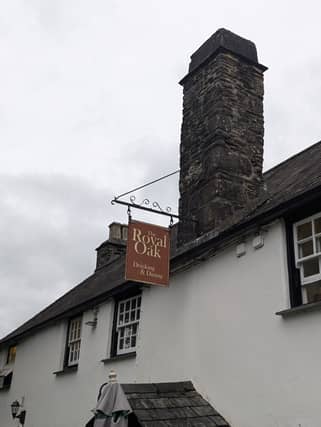
A famous “Highwayman of the Seas”, gets a mention, in the form of Sir Francis Drake. In particular, the fact that all his achievements seemed to be a little too good to be true, for one man to have pulled them off all by himself, without, maybe a bit of Satanic help! It was believed that the Devil was by his side, when he robbed the Spanish; defeated their Armada; brought fresh water to the good people of Plymouth; and sent a message to his wife (in the form of a cannonball) when she was about to marry another, erroneously believing him to have died, during one of his around the world expeditions. His building of Drake’s Leat, was commemorated, for many years after, by the citizens of the city, in the form of an annual “Trout Supper”, in thanksgiving. This “Leat Feast” ritual, was something my friend, Mark, and I, resurrected, a few years ago, by taking people on a walk around the waterway’s moorland remains, before hosting a trout supper (optional) at the nearby Royal Oak in Meavy. Mark would dress as Drake, and I would represent The Devil, as we entertained our guests with tales of their antics...any excuse to dress up!
One chapter I was pleasantly surprised to find included, is dedicated to my favourite pastime of Dartmoor Letterboxing. It gives the date of 1854, when James Perrott, who owned a fishing-tackle shop in Chagford, set himself up as a Dartmoor Tourist Guide. He would encourage his guests to leave behind their business cards, in a glass bottle, that he had secreted at the very remote spot of Cranmere Pool. He would then instruct subsequent visitors to do the same, whilst getting them to contact those that had gone before. This segment continues with a potted history of the spread of the hobby, across the moors, and in its public houses; the introduction of visitor’s books, which are now stored in a Plymouth museum; the setting up of the 100 Club for collectors; and how it survives today, as a useful fund-raising exercise for local charities. I am so pleased to find that my favourite pastime has now entered the realms of folklore!
One final chapter, that I wish to bring to your attention (as it allows me to share with you a special photograph), features what are known as the “Wild Men from the Hills”. This refers to the lawless band of outcasts, that survived in the wilds of Exmoor, and Dartmoor, during the 17th century, respectively, the Doones, and the Gubbins families. The Gubbins, hid out in the depths of, Lydford Gorge, with the ghost of the White Lady waterfall for company, but it’s the Doones of Exmoor I wish to concentrate on, as they were one of the inspirations behind R D Blackmore’s novel, Lorna Doone, the other being the tragic demise of Mary Whiddon, on her wedding day in Chagford.
Those who have read the book (spoiler alert if you haven’t), will know that it culminates in the wedding of our heroine, in the beautiful Oare Church, on Exmoor. During the ceremony, the wicked Carver Doone shoots her through a window, fortunately she survives, unlike poor Mary Whiddon. The church can actually be visited, as part of the Lorna Doone trail. It was one such visitor, that, many years ago, joined us at one of my Monday night meetings at Churston Court, asking our opinion on a photo he had taken whilst there. He claimed to never take pictures of people, just landscapes and interiors, yet on his photo, from inside the church, can clearly be seen a group of people staring out of what is known as the Carver Window. I’ve subsequently visited the place on several occasions, and we have no reason to think it’s haunted, but my theory is that these are fans of the novel, doing the Lorna Doone Trail, and, coming across the spot where their heroine’s life was nearly ended, the strong emotions that engendered, were captured there, for all time, allowing themselves to appear on our friend’s picture, when he visited. A definite case of right place, right time! This takes pride of place in my collection of spooky pictures, as I think it’s one of the best examples of “ghostly extras” caught on camera I’ve ever seen. I include it here, so you can see what you think...